

The Difference Between Those Who Are Ready to Kill and Those Who Are Ready to Die.
🎭 Antigone Read-Along Part I: Lines from 1-855.

Decide.
Will you share the labor, share the work?
Dear friend,
Welcome to the first post of Antigone Read-Along, where we will explore the first half of this play.
I should warn you from the start: this piece turned out to be far longer than I expected — and even so, I was still forced to omit many meanings and symbolisms I had hoped to explore. One quickly realises, when reading truly great literature and attempting to understand it deeply, that one is staring into a vast, endless depth whose bottom can never fully be reached.
I believe that throughout this year and perhaps throughout my life, I will write many, many pieces on Antigone alone. So while this post is my first attempt to engage with what I consider the greatest work of literature ever written, I ask you to treat these reflections with generosity.
Read them as you would watch an unskilled captain at sea: doing his best to steer the ship with the tools and experience he has, aware that the waters are far greater than him.
Thank you for being here. I hope you enjoy the journey.

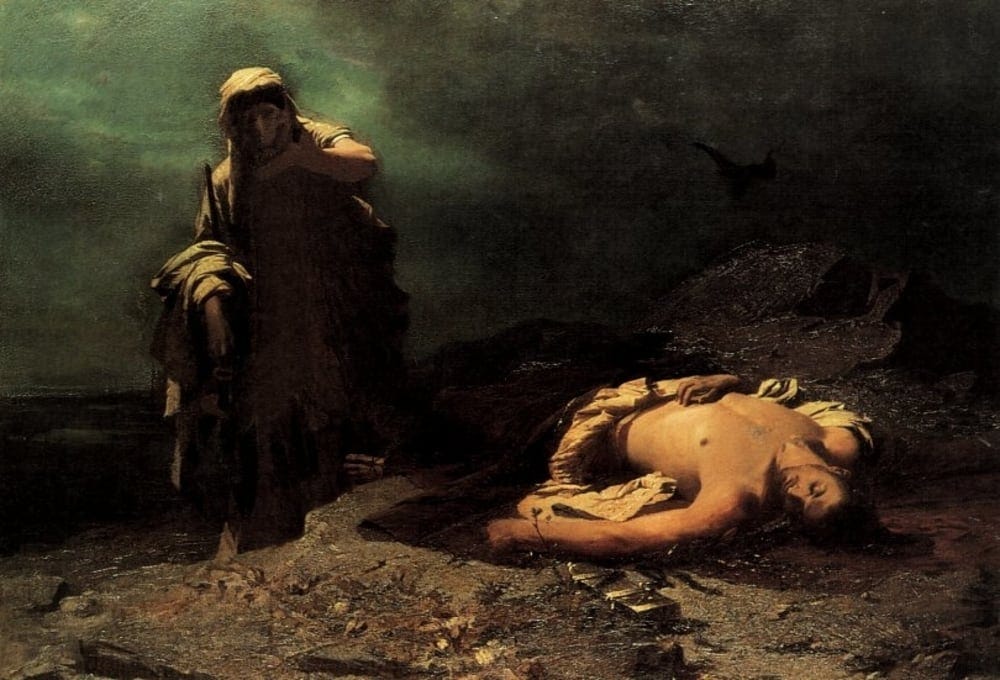
We are drowned in commentary in modern day. We often see films before we even watch them.
I want my reader to imagine themselves as Ancient Athenians, heading to the theatre to see a new play by the great tragedian Sophocles.
They don’t know anything about the plot or about what they are about to witness.
They resemble a little child who expects to taste the flavour of an apple for the first time in their life.
Let us imagine that we are one of them.
We have just arrived and sat on the cold stone of the theatre; we have just seen great actors perform the first scene between Ismene and Antigone.
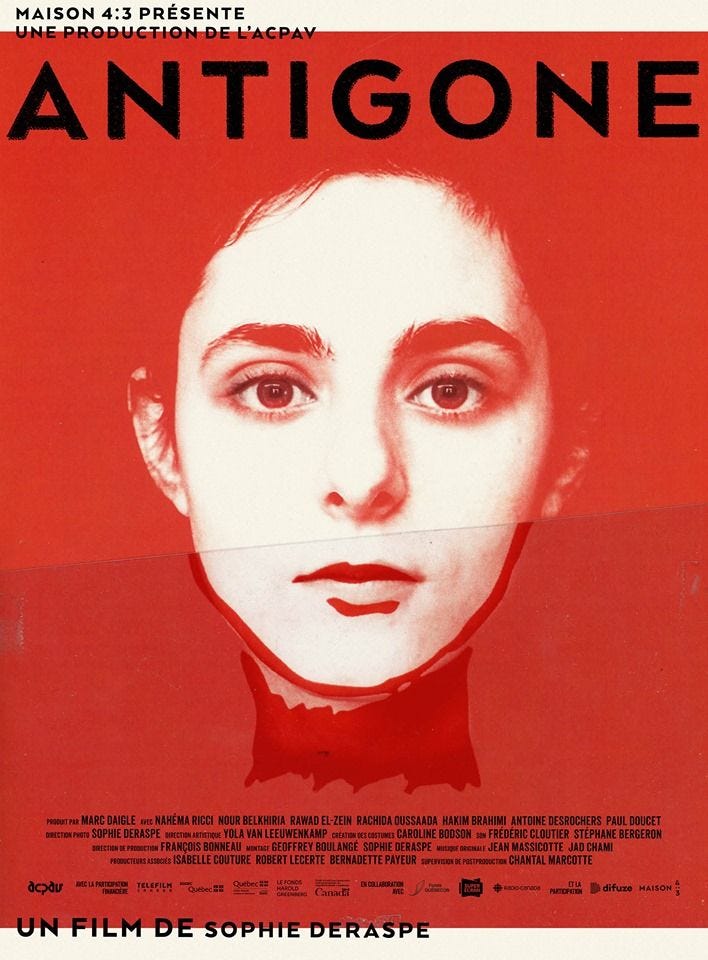
Scene I: Dialogue between Conscience and Prudence. (Antigone and Ismene)
In my exploration of Divine Comedy, I returned again and again to the limits of reason. Our faculty of reason, raised to the highest pedestal during the Enlightenment, is not the only way we perceive the world. In many cases, it is one of the most limiting.
Reason tries to organise reality. It places a frame upon it and tells us what is practical and what is impractical.
But what if the very reason that is meant to guide us through reality is also capable of destroying the very reality it tries to organise?
This question already stands at the threshold of Antigone.
Reason is powerful, but it operates within boundaries. It structures the world by defining limits, assessing danger, and excluding what appears impossible. And as Antigone reveals from its very first scene, reason does not govern every domain of existence. It belongs to the world of the living. It does not rule the world of the dead.
This is why Sophocles begins not with law, not with the state, but with a private conversation between two sisters. In the exchange between Antigone and Ismene, Sophocles unveils two fundamental movements of the human psyche before politics ever appears.
Ismene can be understood as the voice of prudential reason. She does not deny that burying their brother would be right. Instead, she places reality within a frame and declares the act impossible within it. This is precisely how reason functions: it evaluates power, anticipates consequences, and draws boundaries around action. Reason tells us not what is true, but what can be done safely.
Antigone refuses the frame itself.
She understands that the reality Ismene accepts and reduces is sustained by deeper, unwritten structures, and that these structures can be destroyed if certain givens are violated. For Antigone, family stands above the state. Kinship precedes power. And conscience names those acts that must be done regardless of circumstance, fear, or outcome.
This becomes unmistakable in the matter of burial.
The dead no longer belong to the world of the living. They belong to another domain. Burial is not required because neglect offends the gods, but because failing to perform it collapses the boundary between worlds. When the dead are treated as if they still belong among the living, the very fabric of reality is torn.
Antigone understands this instinctively. She does not argue, calculate, or delay. One does not reason about what cannot be violated.
Modern stories help us recognise this structure more clearly.
In A Hidden Life, Terrence Malick tells the true story of Franz Jägerstätter, a man who refuses to salute Hitler. From the standpoint of reason alone, Franz’s decision is indefensible. It would have been far more reasonable to comply, to join the army, and hope to survive the war. His chances of living were undeniably higher.
And yet his conscience refuses the frame entirely. What reason offers as survival, conscience recognises as complicity.
A similar structure appears in The Shawshank Redemption. Prison there functions as a perfect metaphor for reason: a closed system, a fixed reality, a world of clearly defined limits. Within that frame, the conclusion is obvious—life sentence means acceptance; escape is impossible. That is the reasonable assessment.
And yet Andy Dufresne refuses the frame. He does not escape through practicality or negotiation, but through something reason alone cannot justify: hope and refusal to accept the prison as the final word on reality.
These examples illuminate what Sophocles shows us in Scene I of Antigone. Reason can describe a situation accurately and still be blind to what must not be done. Sometimes the most reasonable course of action is precisely the one that endangers the world it claims to preserve.
Antigone does not choose rebellion. She prevents dissolution.
And before the state ever speaks, before Creon appears, Sophocles allows us to see the tragedy already forming: not as a clash of opinions, but as a collision between reason and the deeper structures upon which reason itself depends.

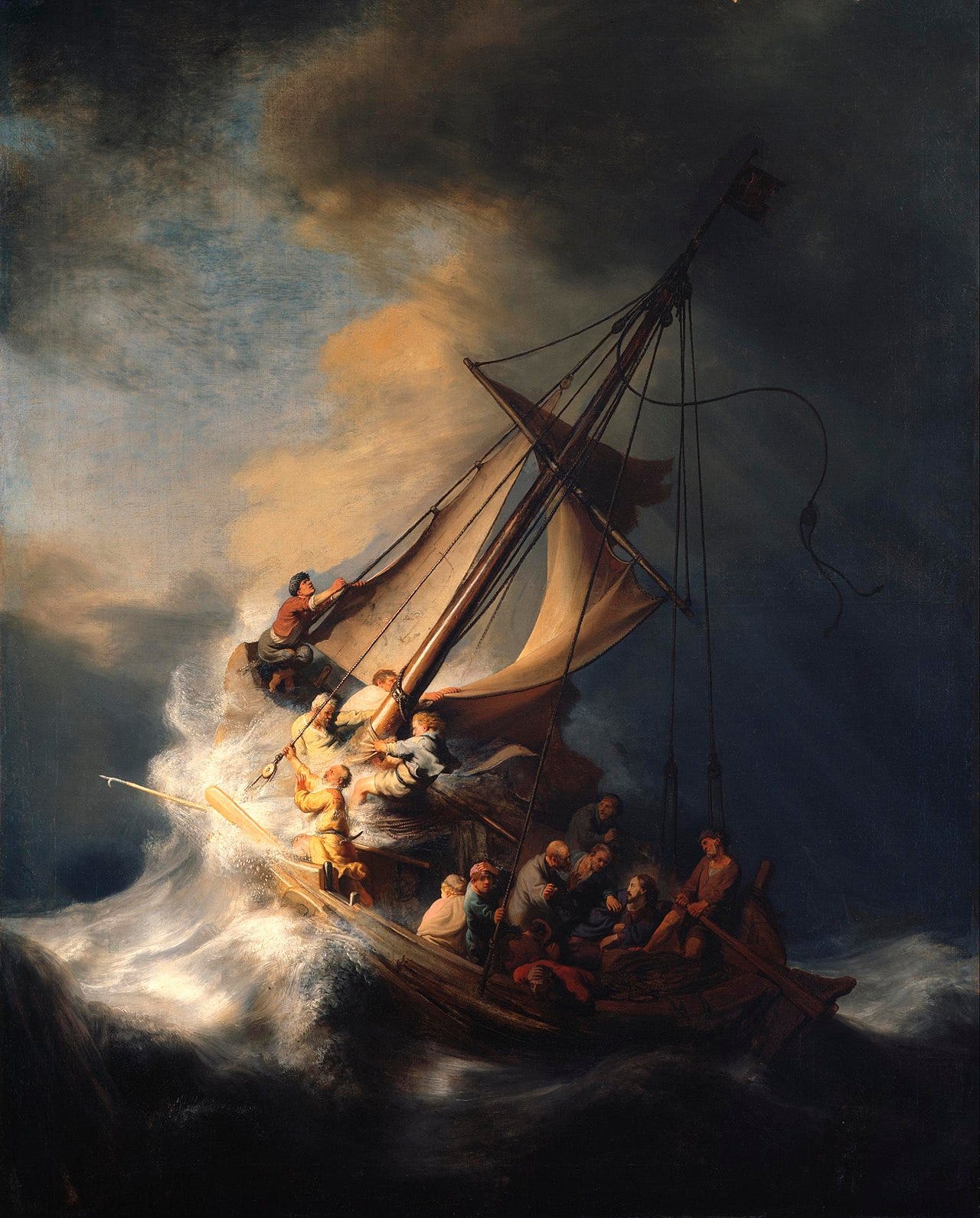
Scene 2: The Ship of State
My reader, may I remind you that you have just survived the Persian Wars. Only forty years ago, Athens was burned to the ground by the Persians.
The fellow Athenian sitting beside you at the theatre—and you yourself—are about to hear Creon’s great speech, perhaps the greatest speech in the history of European literature. And both of you remember vividly that your temples were violently destroyed, your citizens displaced, your polis reduced to ashes just four decades earlier.
Not long after this moment, the greatest of all wars will begin - the Peloponnesian War.
Once again, the state for you was not just simply a place where you grew up and had nice childhood memories. To you the state represented the totalising horizon of human existence, the essential vessel in which virtue, justice, and even the deepest forms of personal connection were actualised.
For Aristotle and Plato without state one could not forge true friendships. Friendship, in its highest form (virtue-based friendship), requires a shared conception of the good and a stable environment in which character can be tested and recognised.Without a solid state, humans are reduced to a state of nature where utility and fear dominate. In such an environment, "friendships" are merely fleeting alliances of convenience. The polis provides the nomos (law) and homonoia (concord) that allow for virtuous philia to exist.
A stable virtuous state can make you either a beast or bring you closer to the divine. In this sense, while family is an essential cell on which the state is born, it is insufficient in itself.
I.
There is a reason why the great Greek orator Demosthenes appreciated Creon’s speech highly, Creon begins by telling his citizens that the ship of state is safe, praises them for their loyalty to the state (i.e. not working against the state), and tells a very ontologically clear for the Ancient Greek mind idea that state stands above friendship, since that very friendship depends on a stable state.
who menaces our country. Remember this:
our country is our safety.
Only while she voyages true on course
can we establish friendships, truer than blood itself.
Such are my standards. They make our city great.
Moreover, Creon is a true patriot. In the Greek world, there were two kinds of people who deserved the severest punishment—to be cast out of the city and denied burial within its walls: those who committed sacrilege and those who were traitors.
Polynices was a traitor. By definition, he was not equal to Eteocles, who had defended the polis. As an Athenian whose cradle was burned by the Persians, aided as well by Greek traitors, how would you have treated Polynices?
II.
Since I have already stretched my reader’s imagination by asking you to feel as though you are watching this play for the first time two and a half thousand years ago, allow me now to ask you to hear its music.
When we spoke about Antigone and conscience in Scene I, we reached a crescendo—an emotionally intense, almost Wagnerian moment. Now, with Creon, we hear the counterpoint: an equally powerful musical harmony, striking us on the opposite scale. Two viewpoints, equally powerful, equally right. Two moral forces set against each other.
This is what makes Sophocles an unsurpassable genius. Think of how stories of individuals confronting authority are written today. Modern authors often tell us in advance who is good and who is evil; the judgment has already been made, and what remains is mere entertainment. Even many of the great authors of the twentieth century do this. Not Sophocles.
Scene III: Creon and Sentry
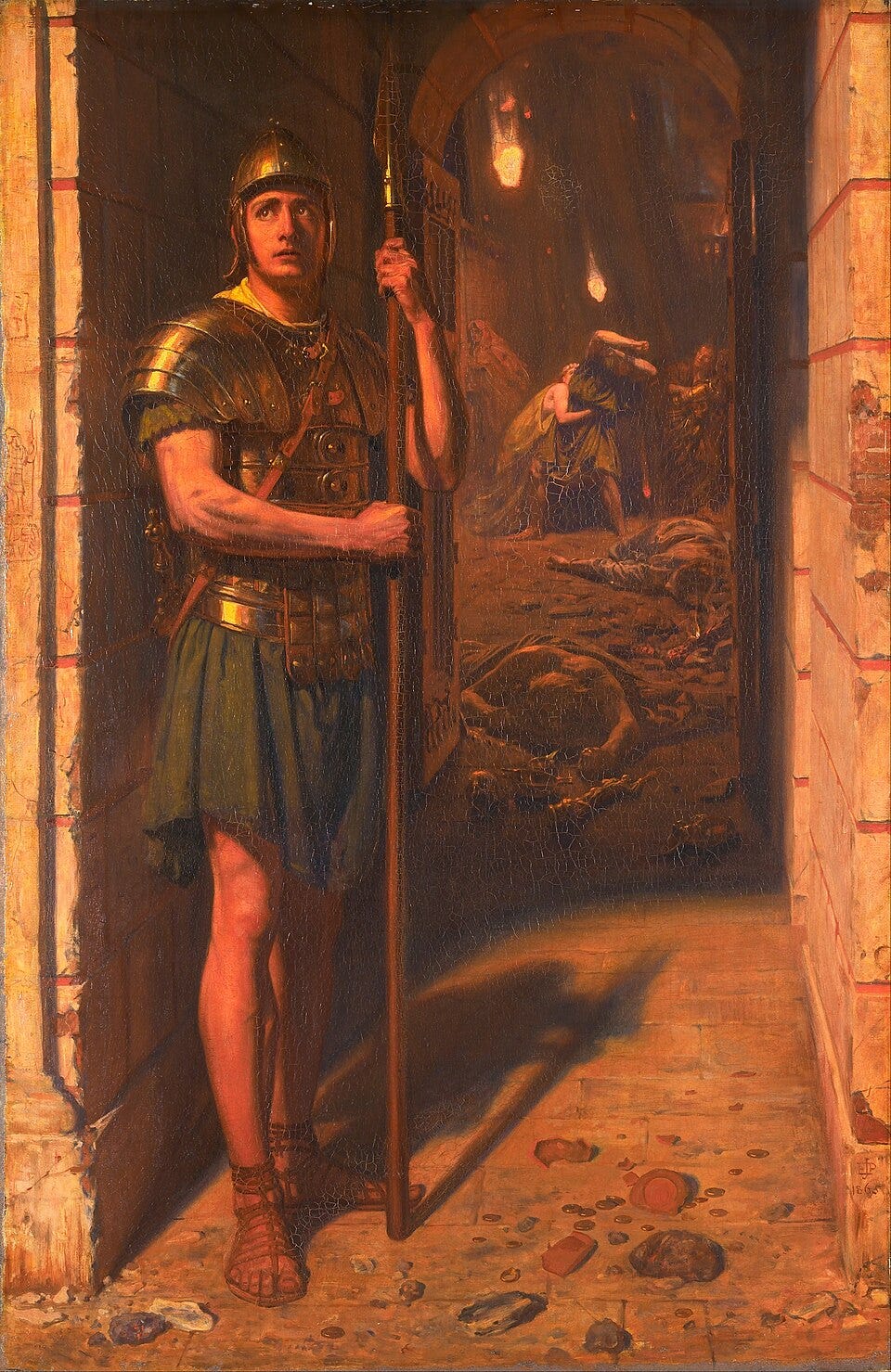
There is no justice in obeying unjust laws. As the play unfolds, we will see that above the polis, which we have explored as being of the utmost importance for the ancient Greeks, stood something else.
In fact, Sophocles leaves us a clue.
Do you remember for whom the severest punishments were reserved?
Yes, traitors and those guilty of sacrilege. Those who acted against the polis were considered among the worst of offenders. Yet above even them stood those who transgressed the divine will of the gods.
I. Sentry
Like a composer who first sets point and counterpoint and then lets them unfold throughout a piece, so did Sophocles. He set the scene, and now we watch the events unfold.
Just as the white ball on a billiard table gives impetus to the coloured ones, so Antigone’s conscience and Creon’s rule have set events in motion—motion that can no longer be steered.
Sentry, shaken and in fear comes to Creon to declare that his first decree that forbids burial of Polynices has been violated.
you can make a short road take forever ...
Sentry is honest but unjust decrees suppress honest thoughts. For our minds switch from desiring to speak the truth to power, to attempting to please power. Sentry asks a question that deserves its own essay:
Where does it hurt you, in the ears or in the heart?
Sentry is asking whether Creon is angry because city is in danger (heart), or because his authority has been challenged.
What is remarkable, and I believe particularly applicable to our own day, is that Creon does not even consider that he might be wrong. He blames money. He accuses the sentry for selling himself for silver.
And our most articulate sentry replies:
Oh it’s terrible when the one who does the judging judges things all wrong.
II. Chorus
Is there a part of this play that does not change one’s heart?
Perhaps, I should have made a year-long read-along of Antigone as we did with Dante. It is much shorter and yet there is so much to be explored.
This scene ends with the voices of chorus, which was interpreted differently depending on an expert, but it clearly represents the silent collective metaphysical conscience. The lines 405-415 are striking. I would love to quote them here in full, but afraid this email might exceed its allowed boundaries.
The man’s path, chorus says, is cyclical. When laws of gods, and laws of earth are respected then mankind reaches greatness, but when laws are intermingled, and humans dare to rule the domain of gods, then everything falls apart. As we have seen in the scene of this ordinary sentry. The instilled fear sparked chaos, distrust, anxiety.
The whole section is beautiful beyond measure!
Scene IV: Antigone interrogated by Creon. (or, when Tyrants try to rule the dead)
When we transgress the rules of gods we corrupt human souls. For the sentry says this (lines 485-490) explicitly, when brings Antigone to Creon:
It’s pure joy to escape the worst yourself,
it hurts a man to bring down his friends.
But all that, I’m afraid, means less to me
than my own skin. That’s the way I’m made.
The scene with the Sentry feels almost primitive in its simplicity.
Here is a man who openly admits that he takes care of his own skin. He tells us that, under other circumstances, he would never betray a friend — but when it comes to escaping the worst, he is ready to do so. Survival comes first.
And this is already revealing.
Creon’s decree has shattered something fundamental: the ordinary human balance between loyalty, fear, and moral instinct. Under unjust power, even basic human qualities begin to erode. A person betrays another person, not because they are evil, but because the structure that allowed values to exist has collapsed.
There is also a quiet but profound tension between the Sentry and Antigone. They are preserving two entirely different things.
The Sentry preserves the flesh.
He protects his body, his life, his immediate survival.
Antigone preserves truth.
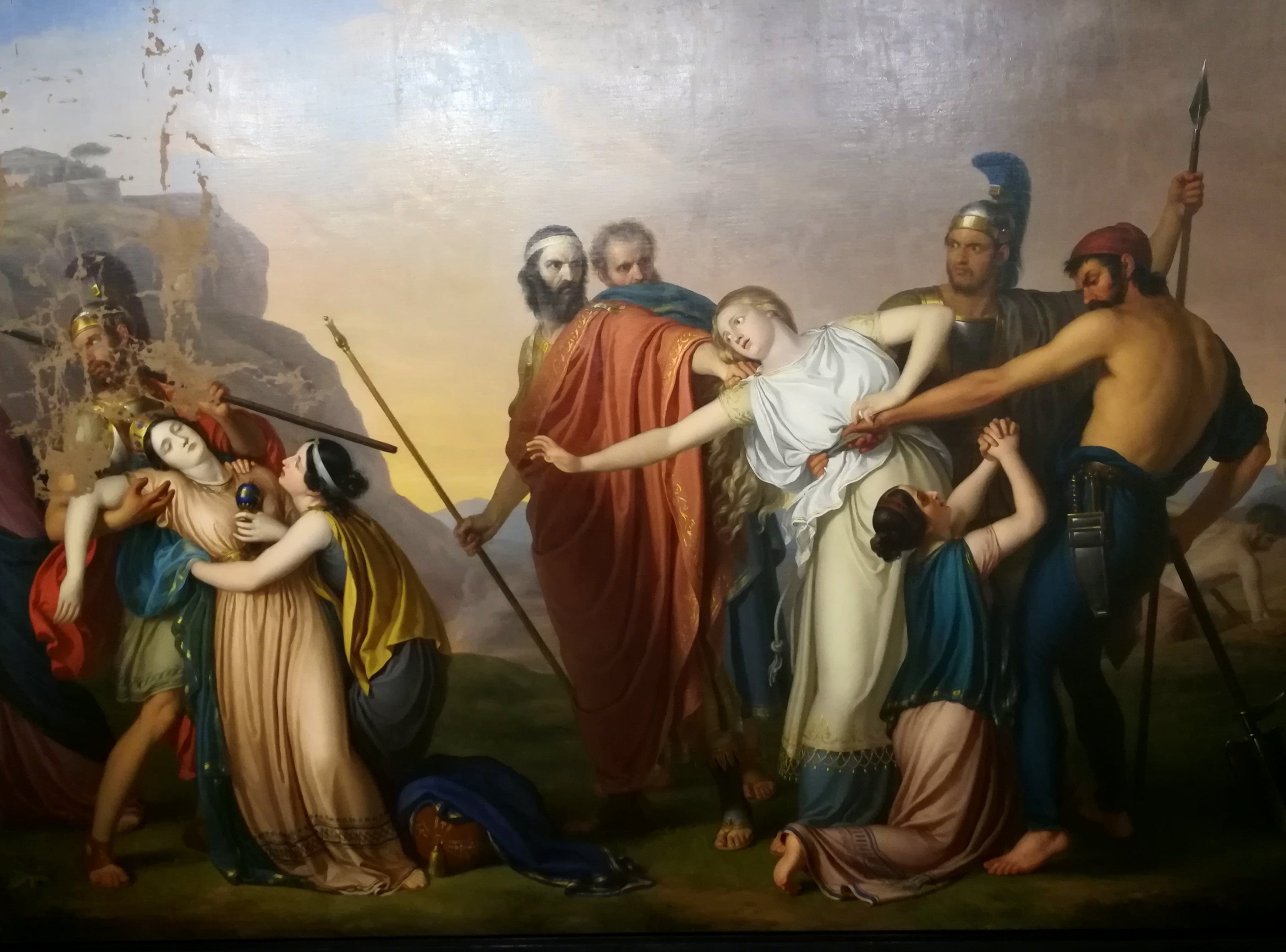
Creon’s unjust law creates a fracture between self-preservation and truth-preservation. Once that fracture exists, a choice must be made and the play shows us both paths.
Antigone’s defiance gives the arrest an uncanny quality. It no longer feels like the state arresting a criminal. It feels as if the state is attempting to arrest conscience itself. Antigone does not deny her actions. She does not bargain. She simply states the truth: Yes, I did it.
She is not concerned with the preservation of flesh, but with the preservation of truth.
No matter - Death longs for the same rites for all
~ line 584
And this is the mind-blowing insight Sophocles gives us through action rather than abstraction: conscience does not float freely in the world. It does not exist automatically. It exists only when someone embodies it.
If we look at the Sentry and search for conscience, we will not find it. There is fear, calculation, instinct — but no conscience.
When we look at Antigone, however, we encounter something immaterial made visible. She becomes the living representation of conscience itself.
Through her, Sophocles shows that conscience is not merely an inner feeling, it is an act. And when conscience acts, power recognises it as a threat.
II.
There is a clear distinction between the living and the dead.
Among the living, a traitor may deserve the severest punishment. Justice can still be debated there. But once a man steps onto the boat of Acheron, he no longer belongs to our jurisdiction. He passes into a realm that lies beyond human reach.
This is where Sophocles’ insight becomes strikingly precise. Laws among the living may be just or unjust, they remain open to argument and correction. But a law that attempts to govern what belongs to the gods is unjust by its very nature. The moment human authority crosses that boundary, it ceases to be law and becomes transgression.
Creon explicitly says that he stretches his domain over to the dead:
Once an enemy, never a friend, not even after death.
~ line 589
Scene V: Narcissistic Virtue
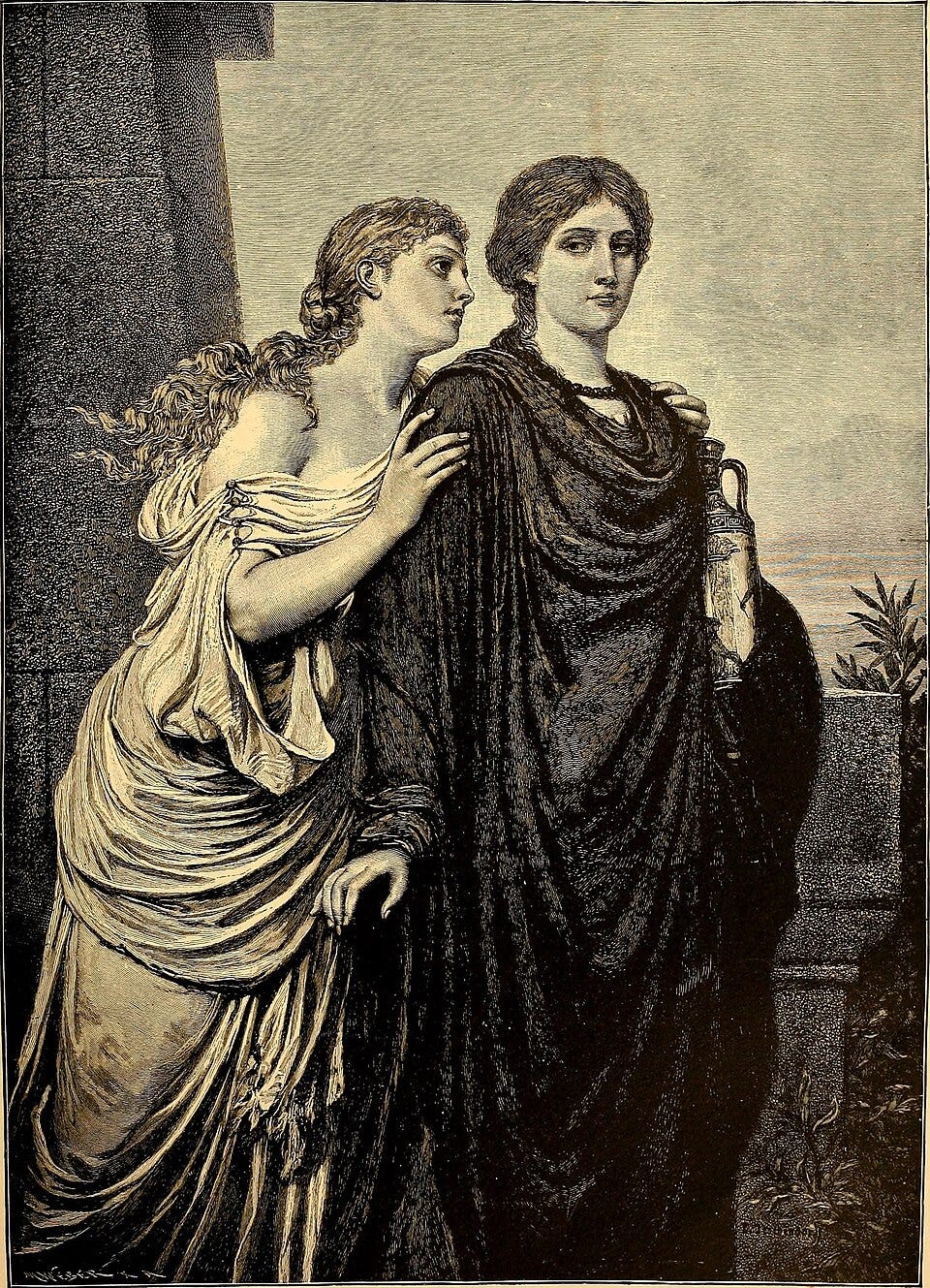
I have no love for a friend who loves in words alone.
~ Antigone, line 611
Narcissistic virtue, and virtue born out of necessity, is what rots the human soul. As was the case with the sentry, whose essence was choked by Creon’s unjust decree, so too is the virtue of Ismene. She is virtuous only in words, not in actions. She is virtuous retrospectively, she did not have courage to do what was right when she could. Ironically, this echoes Creon’s famous speech, in which he claims that one cannot truly judge a ruler by words alone.
Antigone makes something explicit that until this point has only been implicit: she and Creon are not merely disagreeing they are operating within entirely different domains of reality. She names this difference herself. “Your wisdom appealed to one world, mine to another.”
This is decisive. Antigone understands that they are not arguing within a shared framework. Creon speaks from the world of human order, expediency, and rule. She speaks from a realm that lies beyond political calculation altogether.
She then follows this with one of the most astonishing declarations of conscience in the play:
“Courage. Live your life. I gave myself to death long ago, so that I might serve the dead.”
This is not despair. It is not nihilism. It is an affirmation of courage at the highest level. Antigone calls Creon — and by extension, all of us — to live, but to live consciously. She herself has already crossed the threshold inwardly. She has decided what her life is for, and therefore what she is willing to lose.
For me, this moment marks something essential: the sign of a person who does not wish to waste their life. A life, to be fully lived, must contain at least one such statement — a point of inner clarity where a person knows what they serve, and what they will not betray.
Ismene never reaches this point. She has sympathy, fear, affection — but no declaration. No inner sentence that orders her life. Antigone, by contrast, has already spoken hers. And once that sentence is spoken, fear loses its power.
Sophocles shows us here that conscience is not merely a feeling. It is a decision made in advance — and once made, it gives a person a terrifying, luminous strength.
II. Chorus
The role of the Chorus in Antigone is absolutely remarkable. The Chorus functions as the collective human response to what is unfolding before their eyes. And what they are witnessing is conscience in its purest form — heroism, justice, and courage, stripped of all compromise.
But this is where the tragedy deepens.
The Chorus admires Antigone, yet that admiration does not lead to imitation. Instead, it leads to distance. They aestheticize her act, historicize it, mourn it — all from a position of safety. Their reverence is real, but it is inseparable from fear.
In this sense, the Chorus behaves even more timidly than Ismene. Ismene at least stands close to Antigone, even if she cannot follow her. The Chorus stands back. They look, they understand, they feel the force of the truth — and yet they do nothing.
They recognize that Antigone embodies what should be done, what ought to be done, what justice demands. And still, they lack the courage to act accordingly. So they transform action into spectacle, conviction into fate, conscience into tragedy. In doing so, they protect themselves from the unbearable demand her example places upon them.
This is Sophocles’ unsettling insight: the crowd often responds to truth not by following it, but by venerating it from afar. They admire it with fear, revere it with distance, and explain it away so that it never becomes a direct obligation.
And this is why truth never comes from the crowd.
Truth comes from the individual — from the one who is willing to stand alone, to act without permission, and to bear the cost of clarity.
Scene VI: Haemon and His Father
If this play were a symphony, we would have reached its highest note — the moment where the emotional key is fully revealed. From here on, the composer faces the hardest task of all: not to introduce new themes, but to show how those emotions unfold, how they move, and how they destroy.
For Sophocles, this moment arrives in the conversation between Creon and his son, Haemon. Here, emotion reaches its peak. The consequences of Creon’s unjust decree are no longer abstract. They no longer belong to the city alone. They have entered his household. His family.
What began as a political decision now reveals its true cost.
Every social bond has already been strained to the breaking point. The relationship between ruler and citizen - Creon and the Sentry - collapses into fear. The relationship between authority and counsel - Creon and the Chorus - fractures into unease. The relationship between kin - Creon and Ismene, Creon and Antigone - disintegrates under the weight of power.
And now comes the final connection.
Father and son.
With Haemon, the last remaining human bond is tested. What confronts Creon here is not rebellion, not ideology, not defiance but the intimate consequence of his own rigidity. The law he imposed upon the city now returns to him in the voice of his child.
This is the moment when tragedy becomes complete: when power discovers that it cannot insulate itself from the damage it creates. What was imposed outward now erupts inward. The city has been shaken and now the household must pay the price.

My dear reader,
I sometimes want to blame my own disorganisation, my lack of clarity of thought - for when I sat down to write this, I never expected it to become a four-thousand-word essay. And yet, there was simply too much to explore in this extraordinary play.
Each scene felt as though it demanded its own space, its own careful attention, its own meditation. I hope this came through between the lines as I moved rather quickly through those magnificent tensions. I also hope you noticed how much had to be omitted for the sake of restraint, how many paths remained unexplored, how many doors I had to leave unopened.
I am telling you this because I cannot say, honestly, that I have emptied my mind in the way I wanted to. There are still thoughts pressing to be written, insights waiting to be unfolded. There are limits, not only of time and energy, but also the very real limits set by Substack and by how much one can reasonably contain in a single post.
For this reason, I believe I will write several separate pieces throughout the year, each devoted to a single scene. I feel the need to empty myself fully, to do justice to what Sophocles has placed before us.
For now, I hope this piece has enriched your experience of Antigone, and that reading it has brought you closer to this magnificent work of art.
In the next part, we will move into the second, and final, section of the play. It will be shorter, but no less demanding. There are scenes there that, I believe, call for even deeper deciphering.
Thank you, once again, for being with me, and for reading this extraordinary work alongside me.
Vashik, the only people who would think you a poor captain are those who would rather you steer by following the crew’s shouting than by navigating through reference to the stars!
The distinction you draw through Antigone is devastatingly sharp. Creon is the prisoner of what he 'knows'—the rigid, external logic of the state—while Antigone is the vessel for what she 'understands'—an internal, unwritten necessity that transcends the law. It’s a reminder that in tragedy, 'knowing' often leads to a dead end, but 'understanding' is what gives a character their haunting immortality. A brilliant look at the cost of true insight.