
Between Two Doubts: Absolute and Conditional Will
(Paradiso, Canto IV): Indecision, Plato's Astral Idea, and Conditional will


Welcome to Dante Read-Along! ✨
(If this post appears truncated in your inbox you can read it on the web by clicking here. )
Welcome to Dante Book Club, where you and I descend into Hell and Purgatory to be able to ascend to Paradise. Our guide in Paradise is Beatrice, and in this fourth Canto of the Paradiso, we explore Dante’s doubts after visiting the sphere of the moon. You can find the main page of the read-along right here, reading schedule here, and the list of chat threads here.
In each post you can find a brief summary of the canto, philosophical exercises that you can draw from it, themes, character, and symbolism explanations.
All the wonderful illustrations are done specially for the Dante Read-Along by the one and only Luana Montebello.

This Week’s Circle ⭕️
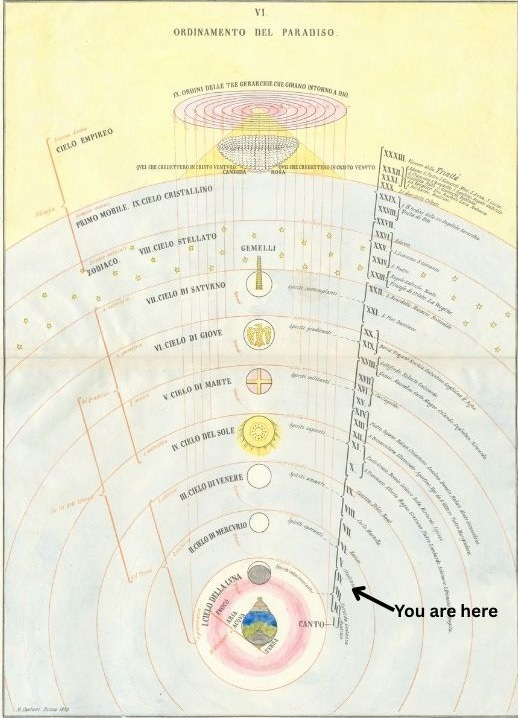
Heaven of the Moon - Dante indecisive between two questions - Beatrice knows his doubts - Her first answer to the question of the placement of souls in the celestial realm - Plato and the kindred star - Her second answer regarding unfulfilled vows - Dante poses a third question.

Canto IV Summary:
Dante began with the imagery of the medieval paradox of the Ass of Buridan, the concept of which goes as far back to Aristotle in theory, if not in name. Used as a logical exercise, the dilemma considered that if an ass found itself between two bales of hay similar in every respect, it would become impossible to exercise its free will in order to choose between the two, and it would starve to death in being unable to make a decision. Similarly would a lamb caught between the equal fears of two wolves, or the dog caught between equal desires of two does find itself unable to act.
Such was Dante’s position as he considered the doubts in his mind that needed resolution, and which made him stand as mute as Buridian’s Ass.
Then Beatrice did just as Daniel did,
when he appeased Nebuchadnezzar’s anger,
the rage that made the king unjustly fierce.
She said: “I see how both desires draw you,
so that your anxiousness to know is self-
entangled and cannot express itself.”
iv.16-18
Beatrice could read Dante’s mind and heart, just as Daniel, in the book bearing his name in the Old Testament, divined both the details of King Nebuchadnezzar’s dream, as well as interpreting the meaning of it, while the wise men of his kingdom were threatened with death for their failure. She knew that he had two doubts warring with each other in his mind, doubts of equal importance, and he did not know which one to ask first.
Then Arioch brought in Daniel before the king in haste, and said thus unto him, I have found a man of the captives of Judah, that will make known unto the king the interpretation. The king answered and said to Daniel…Art thou able to make known unto me the dream which I have seen, and the interpretation thereof? Daniel answered in the presence of the king, and said, The secret which the king hath demanded cannot the wise men, the astrologers, the magicians, the soothsayers, shew unto the king; But there is a God in heaven that revealeth secrets, and maketh known to the king Nebuchadnezzar what shall be in the latter days.
Daniel 2: 25-28
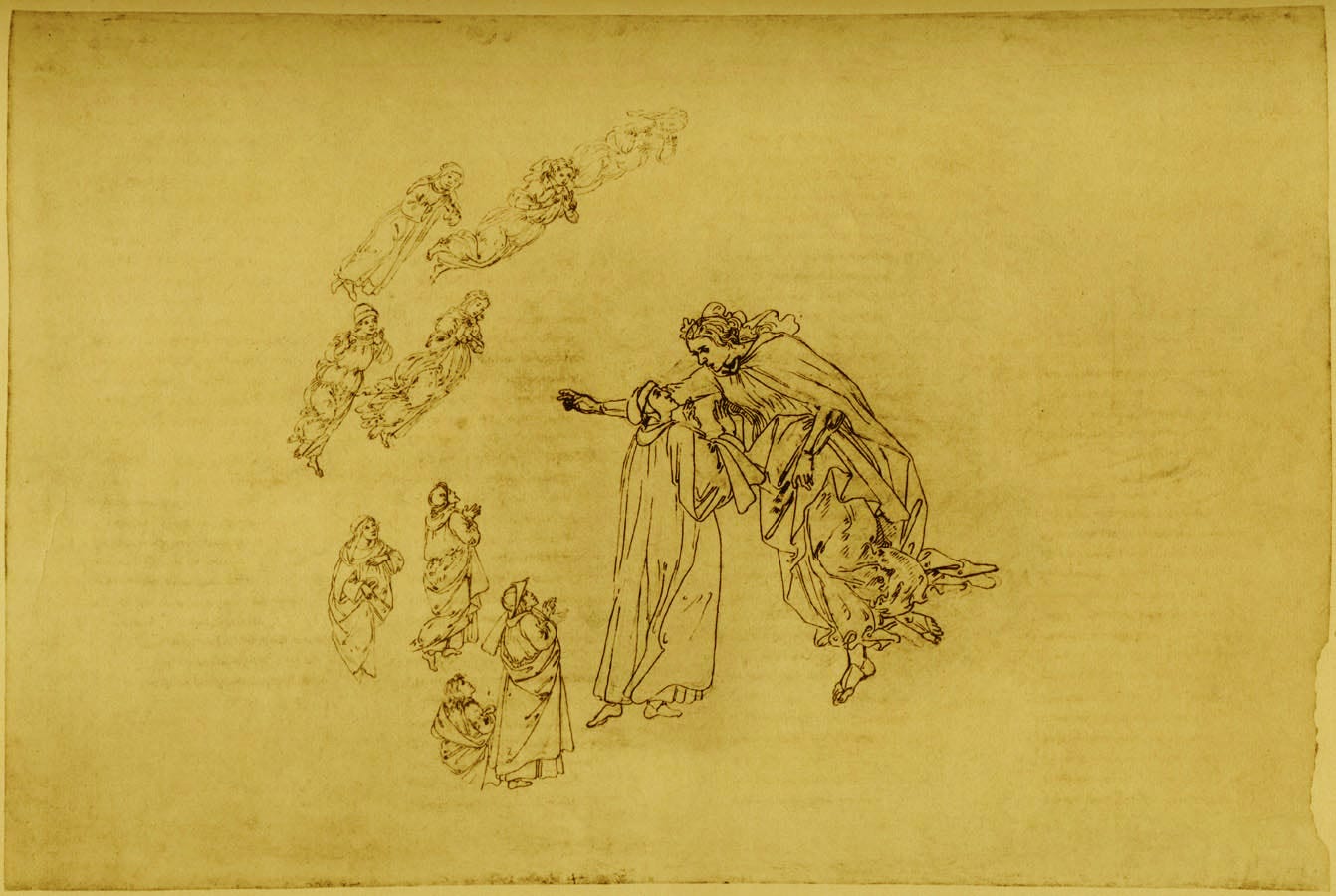
What were those two desires of Dante’s that Beatrice implicitly understood? She would spend the rest of this canto explaining both of those doubts and their answers. His first question ran thus, phrased by Beatrice:
If my will to good persists,
why should the violence of others cause
the measure of my merit to be less?
iv.19-21
His doubt had to do with the placement of Piccarda and Constance in the sphere of the moon for being unable to fulfill their vows, when their circumstances—being abducted and forced to marry—were against their will. The veil upon their hearts (iii.117) was consistent, even if their external circumstances were not. Beatrice would explore this concept using Aristotelian ideas of the nature of the different kinds of will—the absolute and the qualified will—using their circumstance as the opening in which to dive into this philosophy.
His second question was phrased thus by Beatrice:
And you are also led to doubt because
the doctrine Plato taught would find support
by souls’ appearing to return to the stars.
iv.22-24
Plato, at the time that Dante wrote, was largely unknown to the west but for his cosmological dialogue Timaeus, which pointed out the concept that each soul in the universe was assigned to a star where it existed before birth, to which that soul would return at the end of a well lived life. This implied a transmigration of souls—reincarnation—which was not in line with medieval Christian doctrine. This idea had been rejected by the church in 570 A.D. when it was decided that souls were created and placed into the body by God at the time of birth. Dante struggled to reconcile this teaching with the souls living in the moon, since as Piccarda had put it, her ‘station’ was there.
And if they could master these emotions, their lives would be just, whereas if they were mastered by them, they would be unjust. And if a person lived a good life throughout the due course of his time, he would at the end return to his dwelling place in his companion star, to live a life of happiness that agreed with his character.
Plato, Timaeus 42b
Beatrice would address both questions, beginning with the most challenging one, the one with the most ‘venom,’ because while Dante supported the idea that the stars were an influence to some extent, as found in his conversation with Marco Lombardy in Purgatorio, he did not go so far as to imply that free will or morality were not still in play, as Plato’s doctrine would indicate.
This question has the most poison, because the belief that the souls returned to the stars would be contrary to the faith that the true end of the soul is the attainment of bliss in the vision of God in the Empyrean, and would tend to divert the souls from its effort to make itself worthy of this bliss.1
So, those high souls of the prophets Moses or Samuel, of John the Baptist or John the Evangelist, even that of Mary, the mother of Jesus, all the way down to those in the lowest celestial circle of the Moon, all had the same abode, and all had a seat in the Empyrean. Importantly, in arguing the point in contrast to Plato, they would remain there eternally, not to be reborn from that star dwelling home.
The symbolic nature of the souls placed within specific circles related to the capacity of each soul to absorb God's love, rather than being literally further away from it, which implied being of less favor.
They showed themselves to you here not because
this is their sphere, but as a sign for you
that in the Empyrean their place is lowest.
Such signs are suited to your mind, since from
the senses only can it apprehend
what then becomes fit for the intellect.
iv.37-42
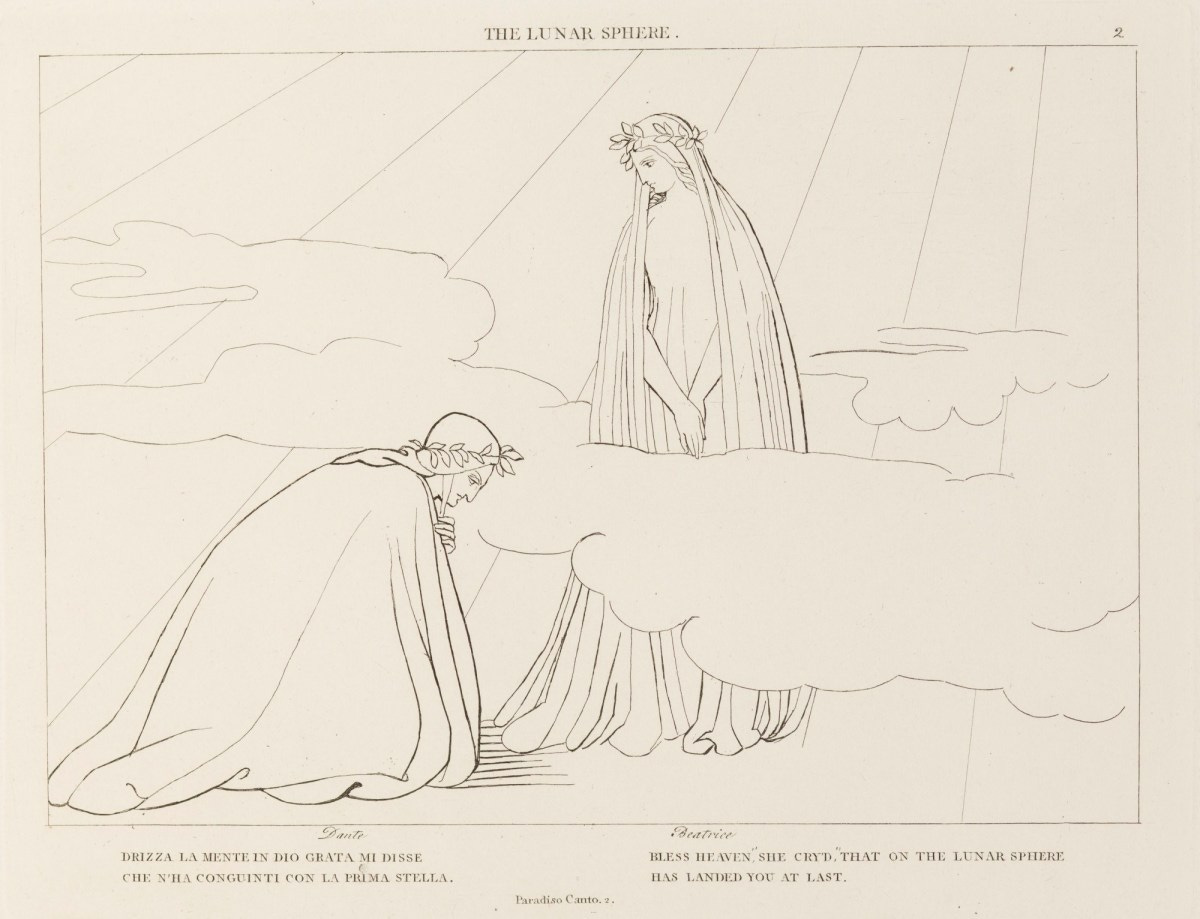
The poet’s invention of this whole scheme is noteworthy, and the reader has only to consider how unsatisfactory (if not impossible) it would have been had the pilgrim risen immediately and directly to the Empyrean, in the first canto of the Paradiso, and remained there for thirty two cantos! By such a device, instead, his journey can pass eventfully upwards by degrees or stages, each stage higher than the last, like so many rungs of a ladder, reaching upward all the way to God.2
Therefore, much of what Dante will see in these realms is for the benefit of his sense perception, for otherwise, how would he be able to understand these ineffable realities?
Nihil est in intellectu quin prius fuerit in sensu
Nothing is in the intellect unless it is first in sense experience.
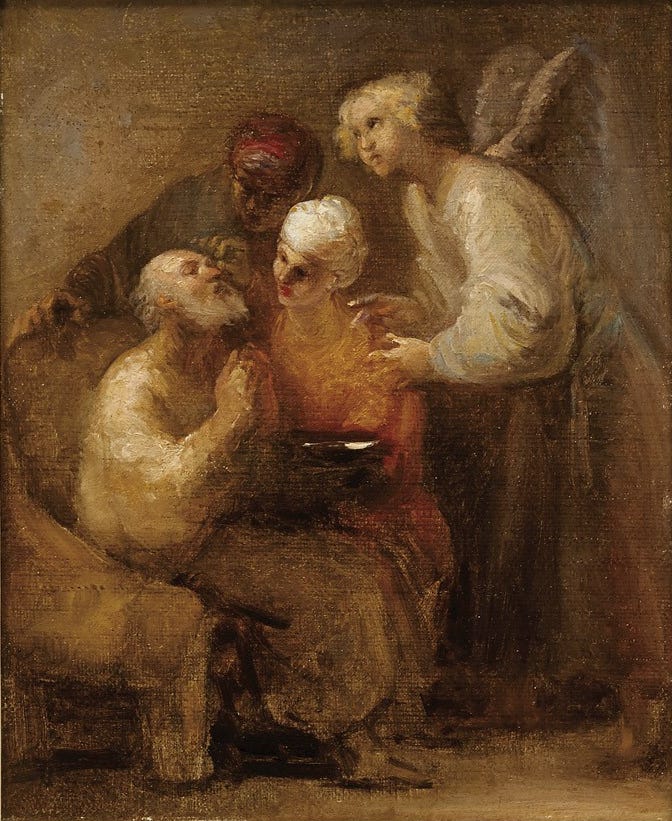
For this reason, she continued, even the church portrayed the archangels as men: Gabriel, who came to Mary at the annunciation, Michael who defeated Lucifer, and Raphael, who granted sight back to Tobit through his son Tobias:
And Raphael said to Tobias: As soon as thou shalt come into thy house, forthwith adore the Lord thy God: and giving thanks to him, go to thy father, and kiss him. And immediately anoint his eyes with this gall of the fish, which thou carriest with thee. For be assured that his eyes shall be presently opened, and thy father shall see the light of heaven, and shall rejoice in the sight of thee.
Tobit 11:7-8
Having begun to address this first, most ‘venomous’ question, Beatrice then moved on to connect these ideas to those of Plato’s conception of the birth and movement of souls. What Dante was witnessing with his own eyes was not in line with Plato’s claims in the Timaeus, which indicated that souls would reside in their home star before a human birth, and return to it after their earthly death, until placed into another human life.
Thomas Aquinas says: ‘Now certain say that those poets and philosophers, and especially Plato, did not mean what the superficial sound of their words implies, but chose to hide their wisdom under certain false and enigmatical phrases, and that Aristotle was often wont to raise objections, not to their meaning, which was sound, but to their words; lest any should be led into error by this way of speaking.3
Plato, along with Aristotle, however, was such an authority, that to call out an error of such a revered figure necessitated a caveat; in this case, that it may have held some truth. In his Convivio, when debating the conclusions of the different philosophers on the nature of the soul, Dante conceded:
If each were to defend his view, it may very well be that we would see truth in all of them; but since at first sight they seem somewhat remote from the truth, we are better off proceeding not according to those opinions but according to the opinions of Aristotle and the Peripatetics. Dante Convivio IV.xxi.3
While admitting to these partial truths, the fulness of that point of view was what led the ancients to consider the planets as the gods:
Plato’s doctrine, which he presents as literally true, is not the reason why Dante has seen souls in the Moon; interpreted symbolically, it may contain some truth, in that the heavens do exercise some influence on human’ natural inclinations towards certain virtues or sins, and may therefore deserve praise or blame accordingly. Even this truth, however, was misinterpreted by pagans in ancient times and led them to worship the planets as gods.4
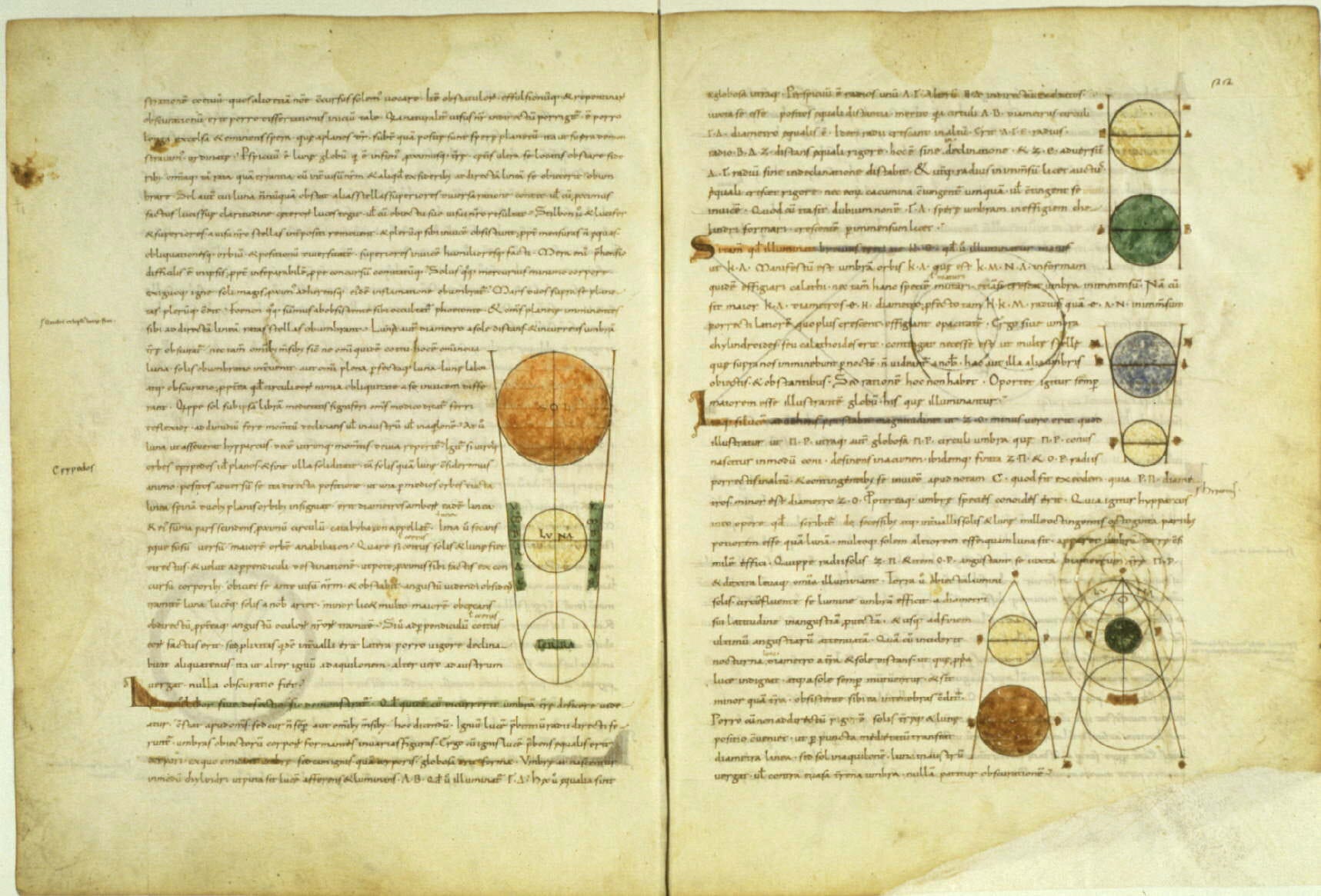
Now that Beatrice had addressed the first doubt about the placement of souls in the heavens, she moved to Dante’s second question, which was less venomous, as any misunderstanding would not cause him to move away from the truths of theology; this was in regard to the effect of violence on vows and the freedom of the will, and all that those ideas entailed.
His doubts, rather than a failure on his part, were a greater proof of his faith. She presented an idea that was like the modern thought experiment in a university philosophy class:
If violence means that the one who suffers
has not abetted force in any way,
then there is no excuse these souls can claim:
for will, if it resists, is never spent,
but acts as nature acts when a fire ascends,
though force—a thousand times—tries to compel.
iv.73-78
What is Beatrice saying here? She was pointing out the first use of the will, which we can call the absolute will, that which stays strong even when compelled externally, through violent action against it:
Involuntary actions seem to be those that arise either from violence or from ignorance. The ‘compulsory action’ is one whose principle is from outside and to which the person involved or the recipient contributes nothing, for example, if he is driven somewhere by the wind, or if he is in the power of other men.
Aristotle, Nicomachean Ethics III.i.1109-1110
Even with this external action against the sovereign will, it is not extinguished, but rises to act on its own behalf again and again, just as a flame that is attempted to be dampened will continue to rise, lacking its complete extinguishing, as it would in death.
for will, if it resists, is never spent,
but acts as nature acts when fire ascends,
though force—a thousand times—tries to compel.
iv.76-78
With this being the course of understanding, Beatrice pointed out that if the absolute will stayed in that ‘bent’ or ‘fire dampened’ space, it would eventually accept the outcome, as Piccarda and Constance finally accepted being away from the monastery and succumbing to their fate—this we will find is the qualified will; that outside force bent their will until they could not then act as they ideally would act, that is, to return to the convent.
Had their will been as whole as that which held
tenacious Lawrence to the grate and made
unflinching Mucius punish his own hand,
then, once they had been freed, they’d have gone back
to find the path from which they had been dragged;
but seldom can the will be so intact.
iv.82-87
The examples that Beatrice gave, one pagan and one Christian, of those whose wills could not be bent at all, were so strong and so exemplary as to be rare in their expression. St. Lawrence of Rome was a martyr in upholding the tenets of the church:
Being commanded by the prefect of Rome to deliver up the treasures of the Church, which had been entrusted to his charge by Pope Sixtus II, he replied that in three days he would produce them. On the expiration of the appointed time he presented to the prefect all the sick and poor to whom he had given alms, with the words, “Behold the treasures of Christ’s Church.” The prefect thereupon directed St. Lawrence to be tortured, in order to make him reveal where the treasures were hidden. But, torture proving ineffectual, he was stretched on an iron frame with bars, like a gridiron, beneath which a fire was kindled so that his body was gradually consumed. In the midst of his agony he is said to have remained steadfast.5
Mucius, a Roman soldier, was also steadfast in the case of external circumstances:
[He] made his way into the enemy’s camp with the intention of killing Porsena [the king]; by mistake, however, he stabbed the king’s secretary instead of the king himself. Being seized, Mucius was ordered by the king to be burned alive, whereupon he thrust his right hand into a fire, which was already lighted for a sacrifice, and held it in the flames without flinching. Porsena, struck with admiration at his fortitude, ordered him to be set free.6
Even with these examples, Beatrice knew that Dante needed more clarity in order to fully understand this concept of the will that had not been able to fulfill its vow. She went on to address what Constance meant when saying that the veil was continually over her heart, no matter the circumstances. She explained that it was like considering the lesser of two evils;
An absolute will consents not to the wrong,
but the will does consent to the extent it fears,
if it draws back, to fall into still greater harm.
iv.109-111
Dante admits that the will can frequently bend under external pressure and give partial consent to the act of violence in order to avoid worse dangers. This occurred in Piccarda’s case. And once that is understood, there is no discrepancy between her words and those of Beatrice.7
Here she explained that the absolute will—that will which Piccarda and Constance kept as a veil over the heart, since their true desires could not be fulfilled—was in contrast with the qualified will, which understood the harm that would come to the body if it fought back absolutely, and in which it had to consent to the degree necessary to preserve life and body, and to do the least harm.
Thus was the contradiction resolved.
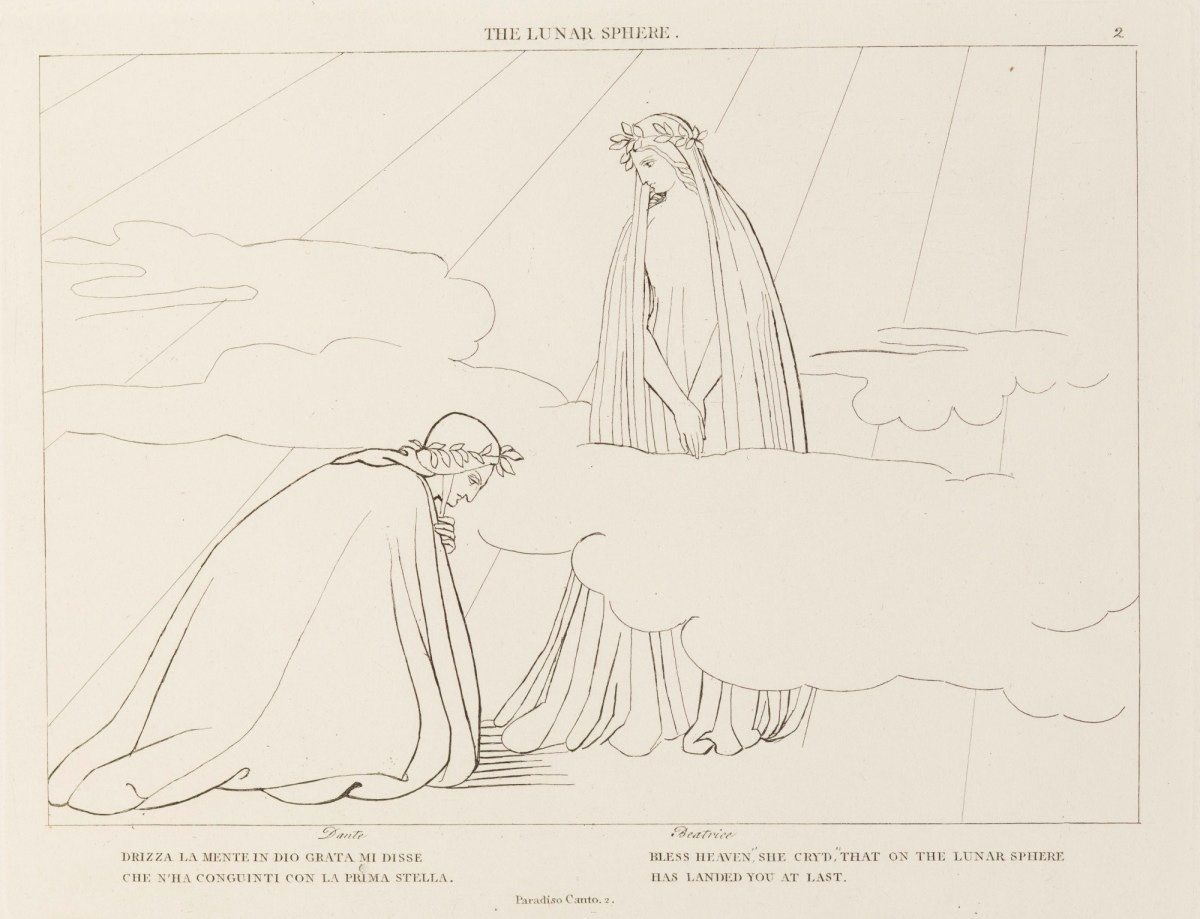
So divine were the words of Beatrice in explaining these difficult concepts to Dante, and such was his acceptance of her words, that in his “ecstatic moment of intellectual celebration”8 he cried out in his bliss:
‘O beloved of the First
Love, o you—divine—whose speech so floods
and warms me that I feel more and more life,
however deep my gratefulness, it can
not match your grace with grace enough; but He
who sees and can—may He grant recompense.
iv.118-122
Dante’s vision had cleared until he was able to embody the understanding of her teaching; and so will his vision clear with every lesson learned throughout Paradiso. Doubt, while at first seeming to be a negative indication of acceptance and understanding, in fact, sprung from the root of truth, urging us on to find the answers we seek so earnestly:
Therefore, our doubting blossoms like a shoot
out from the root of truth; this natural
urge spurs us toward the peak, from height to height.
iv.130-132
With these doubt at rest, Dante introduced the fact that yet another question lingered at the back of his mind; for those vows unfulfilled, would there be any way for that soul to balance the scales of justice, to compensate for that which they had left undone?
The answer was yet to come, and in the pause, Dante was overcome with the love shining from Beatrice’s eyes.

💭 Philosophical Exercises
Sense does not grasp the essences of things, but only exterior accidents. No more does the imagination which only apprehends the likenesses of bodies. The intellect alone grasps the essences of things.
~ Thomas Aquinas
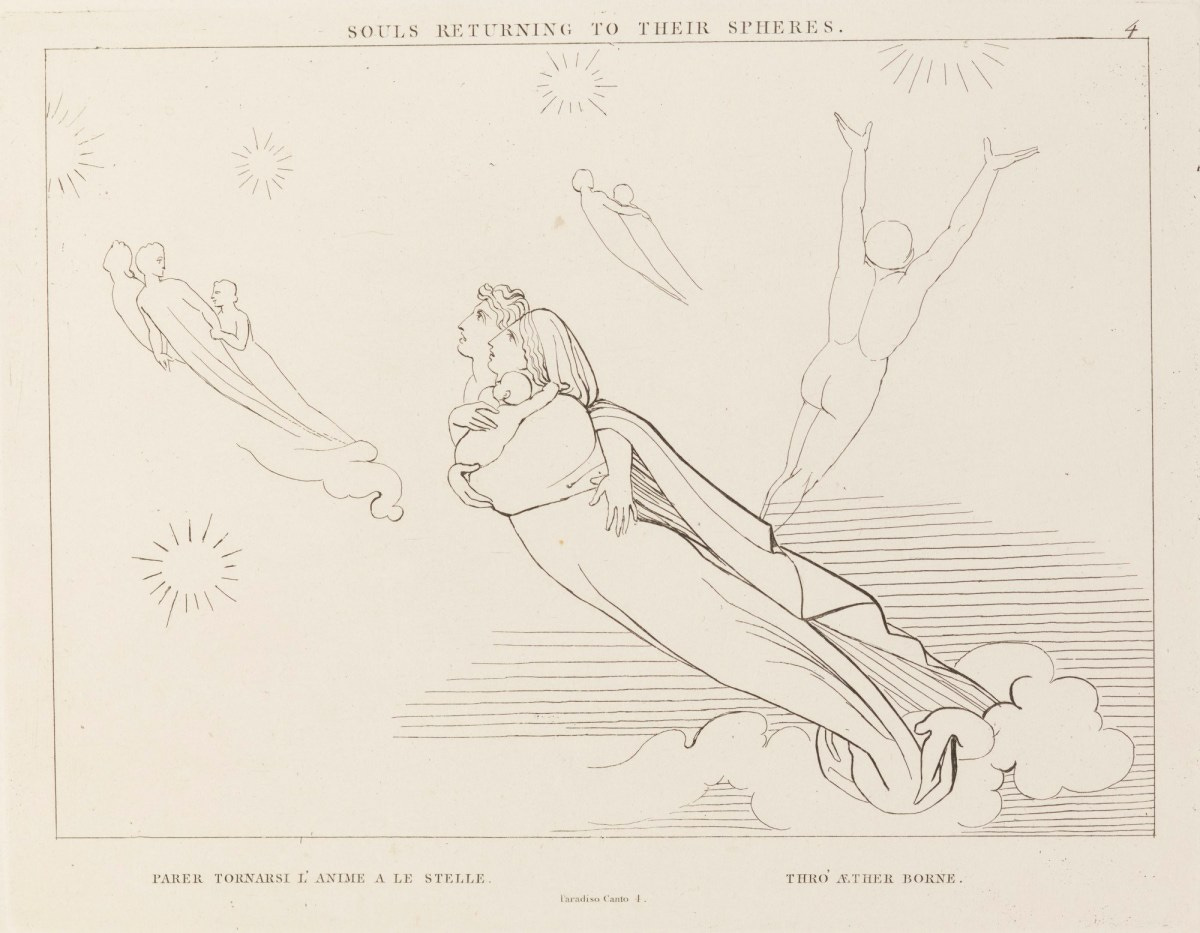
After John Flaxman RA (1755 - 1826)
Before a man bit into one of two
foods equally removed and tempting, he
would die of hunger if his choice were free;so would a lamb stand motionless between
the cravings of two savage wolves, in fear
of both; so would a dog between two deer;thus, I need neither blame nor praise myself
when both my doubts compelled me equally:
what kept me silent was necessity.
~ lines 1-9, Canto IV
The beginnings of both the third and fourth cantos of Paradiso share the same philosophical aim: learning how to see, or more precisely, how to direct our attention. Dante finds himself caught between two equally tempting foods, motionless between the cravings of two savage wolves. How often does our own mind fall into a similar trap, paralysed by opposing desires, and freeze itself?
Dante mentions Nebuchadnezzar, who received a divine vision in a dream—a message sent by God—and yet could not recall or understand it on his own. Only with the help of the prophet Daniel, who both remembered and interpreted the dream, was its meaning revealed. In a similar way, Beatrice now acts as an interpreter of divine wisdom.
Like Daniel, she helps the pilgrim understand that the divine does not reveal itself directly or in the same way to all souls; it adapts to their capacity for perception.
I.
Beatrice begins her assistance by pointing to us out that we should train our attention to direct itself towards the most important, the most damaging element first. In the case of Dante, who is caught between the two, she chooses to focus on the astral question.
These are the questions that, within your will,
press equally for answers; therefore, I
shall treat the most insidious question first
~ lines 25-27
The Hollanders translate the word as “venom” rather than “insidious”, so it’s worth pausing on this idea of a venomous belief that Dante the pilgrim holds.
The error stems from a Platonic view that souls return to their respective stars after death. Beatrice rebukes this notion, saying that Plato presented it as if it were a literal fact, as though souls truly return to the stars from which they came. But this is false.
The stars and faces Dante sees are all part of the same Empyrean, the same divine presence. Piccarda, for instance, appears in the sphere of the Moon, but not because her soul is limited to that place. Rather, the assignment is pedagogical: it allows Dante (and us) to understand the workings of divine order in a way the human mind can grasp.
And this is why the Bible condescends
to human powers, assigning feet and hands
to God, but meaning something else instead.

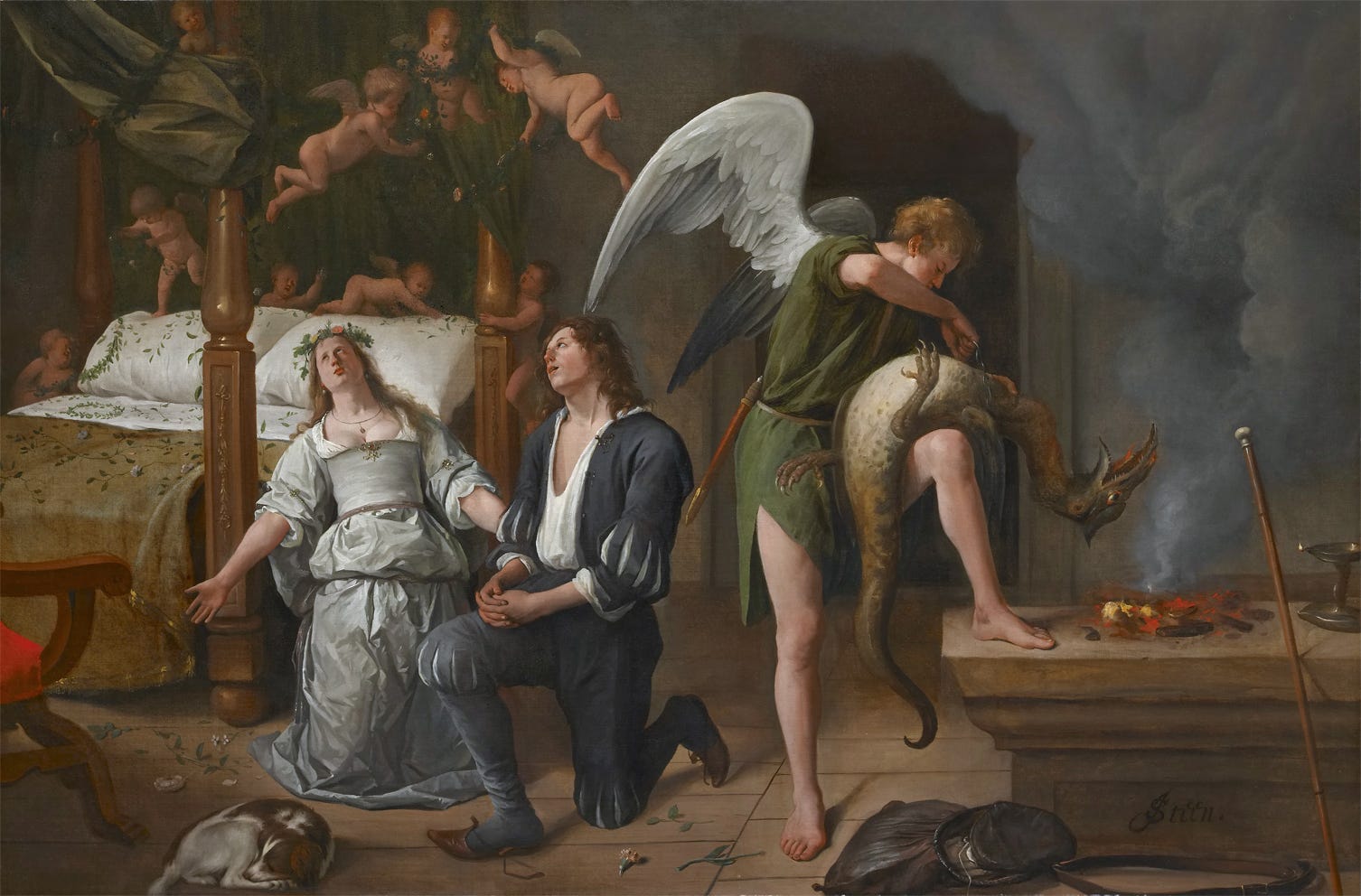
And Gabriel and Michael and the angel
who healed the eyes of Tobit are portrayed
by Holy Church with human visages.
~ lines 43-48
The higher beings and realities are presented to our untrained minds in forms we can grasp. Hence angels are pictured with wings and faces; and yet if my reader searches how they were truly described, they look nothing like beautiful bird-like creatures with mesmerising wings.
Scripture even gives God “hands and feet” so we can imagine Him. In this same key Beatrice invokes Raphael and Tobias: Raphael (Book of Tobit) enables Tobias to heal his father’s blindness (Tobit 11:2–15).
Of course, by referring to the story of Raphael and Tobias, Dante shows us that the father’s blindness was not literal but allegorical.
There are only a few people in the world who are physically blind, unable to see their surroundings but there are many more who are blind in their inner heart: they can see the world around them, but cannot perceive the beauty of the universe.
II.
Before introducing the second venomous belief, it is worth pausing on Beatrice’s rebuttal of Plato’s idea that souls return to their stars. Her critique is not just theological it is also a defence of free will.
For if every soul simply returns to the star from which it descended, then character is not the fruit of labor, nor the result of deliberate and purposeful choice; it is merely the outcome of being born under the right star, the right planet. Such a view would mean that all is determined, and nothing truly chosen.
The second question that Beatrice addresses is less insidious and yet important:
To mortal eyes our justice seems unjust;
that this is so, should serve as evidence
for faith—not heresy’s depravity.

But that your intellect may penetrate
more carefully into your other query,
I shall—as you desire—explain it clearly.
~ lines 67-72
Hollander notes that every soul we encounter in Paradiso will speak of their absolute will. We briefly explored the nature of the will in the previous canto: there is an absolute will and a conditional will. The former is the sincere virtue one strives to attain; the latter is life’s test whether one can remain faithful to that goal even when faced with obstacles.
The examples that we see are moving, and it is worth drawing the attention of my reader that while the examples of imitation in Inferno were always negative, in Purgatorio negative and positive, in Paradiso they are always positive.
The first example is of St Lawrence who did not yield and did not surrender his conditional will. St. Lawrence was the deacon who, when asked for the Church’s treasure, presented the poor as its treasure and was roasted on a gridiron.
The we have got Mucius Scaevola who during Lars Porsena’s siege of Rome infiltrated the camp to kill the king and mistakenly killed the secretary (epic fail).
He was seized and thrusted his right hand into the sacrificial fire, holding it there without flinching. Awed, Porsena freed him and sued for peace; Mucius is thereafter Scaevola (“left-handed”). Hollander remarks this “makes the message even more painful”: one must be prepared to do violence even against oneself in the service of liberty.
These are examples of ideals whose conditional will never surrendered to the earthly challenges.
III.
Dante pairs two key elements in this canto. First, Beatrice explains that fate is not governed by the stars, and that the divine plan is so intricate, so vast, that it must be revealed to us through symbols and allegories as one might explain a complex subject to a child, using stories or metaphors suited to their level of understanding.
The second element is the nature of the will. If our fate is not determined by celestial forces, then it is up to us to train our vision to cultivate a sincere absolute will, and a conditional will that remains steadfast even in adversity.

This Week’s Sinners and Virtuous 🎭
(Themes, Quotes, Terms and Characters)
I. The Nature of vows
I want to know if, in your eyes, one can
amend for unkept vows with other acts—
good works your balance will not find too scant.”

Then Beatrice looked at me with eyes so full
of sparks of love, eyes so divine that my
own force of sight was overcome, took flight,
~ 136 - 141
There’s one more unresolved question that Dante poses to Beatrice which will be answered in the next canto. Here, however, I want to draw to my readers attention that the ending of almost each canto in Paradiso is united with the next.
II. Eagerness - Fear - Eagerness
The opening lines with triple similes reveal an interesting nature of our indecisive will. Man/Lamb/Hound - eagerness that stops our will, then (almost always) intermingled fear, and eagerness again.
Quotes 🖋️
(The ones I keep in my journal as reminders of eternal wisdom):
"Before a man bit into one of two
foods equally removed and tempting, he
would die of hunger if his choice were free;

so would a lamb stand motionless between
the cravings of two savage wolves, in fear
of both; so would a dog between two deer;

thus, I need neither blame nor praise myself
when both my doubts compelled me equally:
what kept me silent was necessity."

~ lines 1-9, Paradiso, Canto IV

Charles S. Singleton, Commentary on Paradiso 77
Singleton 79
Singleton 82
Allen Mandelbaum The Divine Comedy 716
Singleton 88
Singleton 88
Robin Kirkpatrick, Paradiso 344
Kirkpatrick 343