
Dante's Independence
(Paradiso, Canto XXXI): Departure of Beatrice, Bernard of Clairvaux


Welcome to Dante Read-Along! ✨
(If this post appears truncated in your inbox you can read it on the web by clicking here. )
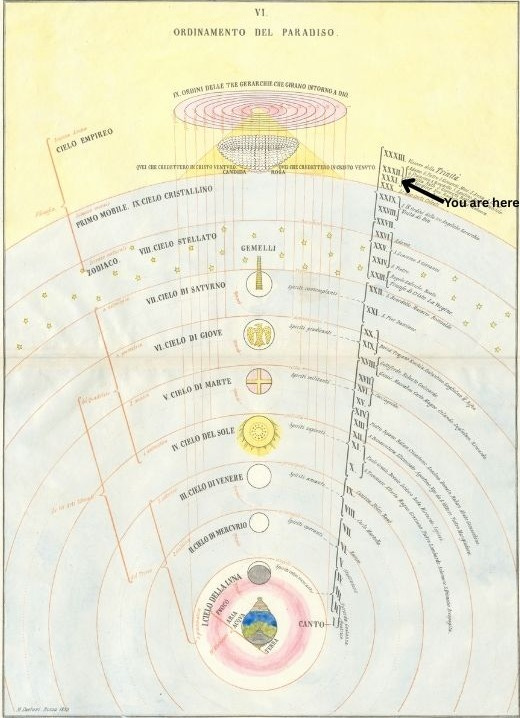
Welcome to Dante Book Club, where you and I descend into Hell and Purgatory to be able to ascend to Paradise. Our guide in Paradise is Beatrice, and in this thirty first Canto, Dante looks upon the Celestial White Rose of Heaven. You can find the main page of the read-along right here, reading schedule here, and the list of chat threads here.
In each post you can find a brief summary of the canto, philosophical exercises that you can draw from it, themes, character, and symbolism explanations.
All the wonderful illustrations are done specially for the Dante Read-Along by the one and only Luana Montebello.

This Week’s Circle ⭕️
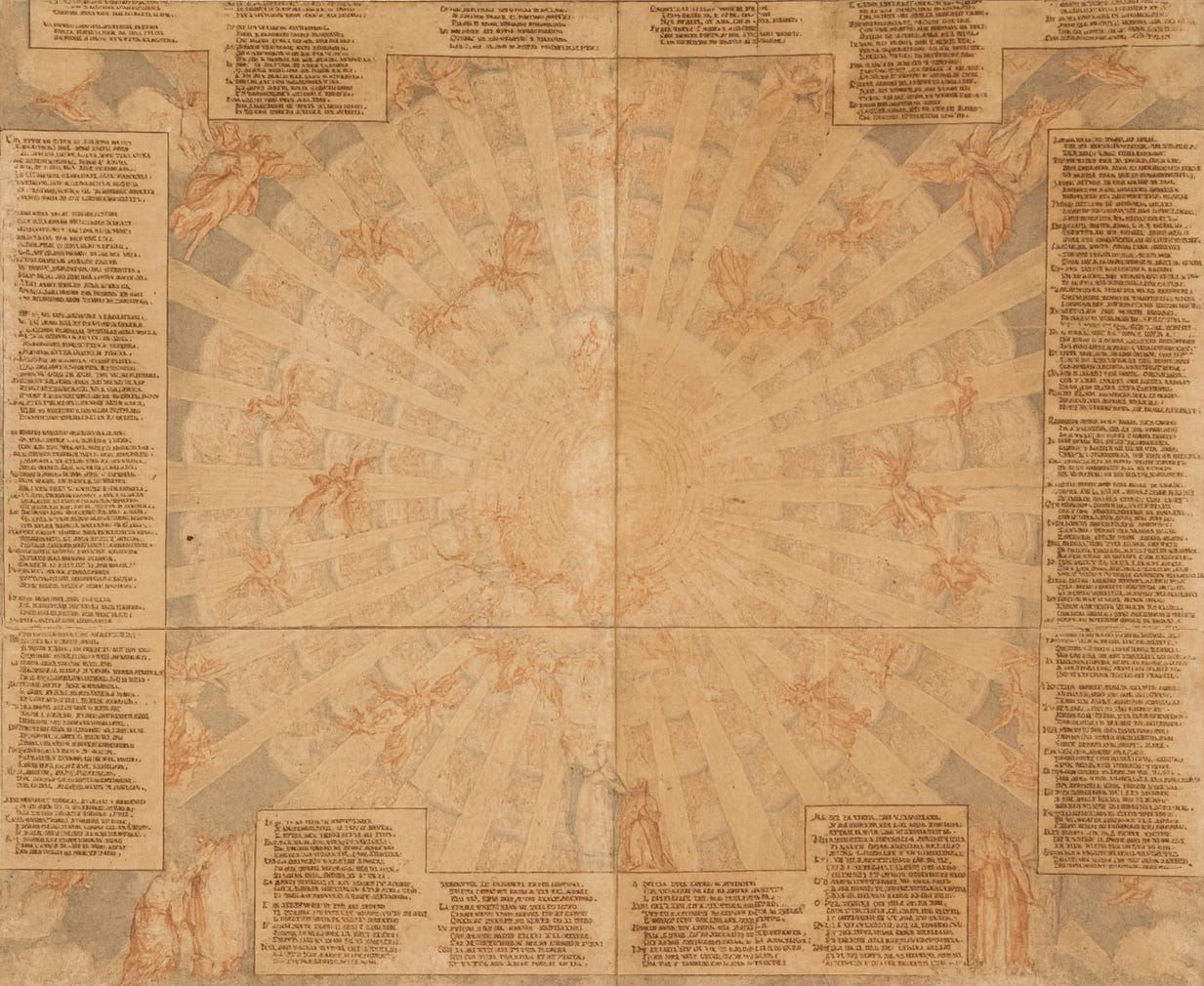
The Celestial White Rose of the Empyrean - The petals filled with rows of the blessed - Beatrice takes her place in the heights of the Rose - St. Bernard the contemplative takes her place - They watch the pageant of the angels ministering to the blessed - St. Bernard directs his vision higher - The Virgin Mary seated at the height of the Celestial Rose.

Canto XXXI Summary:
The magnificent Celestial White Rose was unfolded in all of its radiant glory before Dante’s eyes, that representation of the Church Triumphant, filled with the souls of the redeemed, those blessed inhabitants of Paradise, the elect, the Saints; the petals were filled with their thrones.
The figure of the rose seems to be Dante’s own, although Paradise is sometimes represented in roselike form in early Italian art. The rose, too, was sometimes used as a symbol of the Passion. On the fourth Sunday of Lent, the Pope blesses a gold rose with a ceremonial that indicates an association of this flower with Christ and Heaven.1
While that host of the elect had their places in the petals of the rose, the angelic beings, who forever had the sight of their hearts toward God, flew like bees from the center of the flower back up toward the One, toward God, their duty a labor of sweetness. Their countenances were of fire, their wings golden, and their robes the most brilliant white.
As they flew into the center of the flower and back up over the petals, the blessings of the highest One were poured onto the elect through the beating of their wings, like honey brought from above and deposited into the celestial rose. No matter how many of them flew about, the light of God was such that nothing could obstruct it.
Nor did so vast a throng in flight, although
it interposed between the candid Rose
and light above, obstruct the sight or splendor,
because the light of God so penetrates
the universe according to the worth
of every part, that no thing can impede it.
xxxi.19-24
Similarly, the goodness of God is received in one way by the separate substances, that is the angels, who have no coarse bulk of matter, as if they are transparent through the purity of their form.
Dante, Convivio III.vii.5
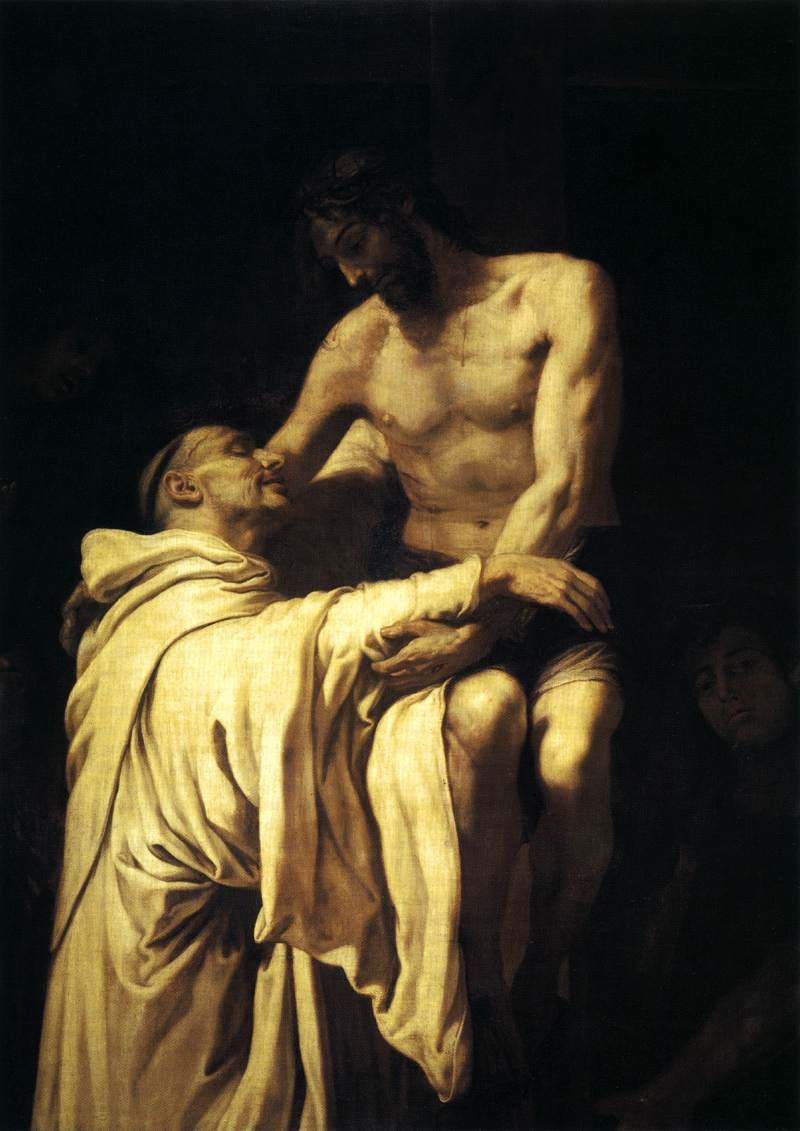
The elect within the Rose were from all eras of time, ancient and new, and all used both their will and their intellect, purified, to gaze upward into the light of God. Dante said a prayer that the Light of the Three in One, upon which those souls gazed, would also extend down to the suffering upon earth, as that vision was the only thing that could bring true peace in troubled times.
Dante compared his sense of amazement to what the barbarians of Northern Europe had felt—those under the constellations of Helice and Arcas, the Great Bear and Little Bear—upon first seeing Rome and the Lateran palace. That palace had once been home to Emperors and was now the home of Popes, more magnificent than anything they had ever seen. Parallel that amazement to his perspective of being one not simply looking upon a new city, but as a humble Florentine gazing upon the wonders of the highest heavens as a living man, having crossed the final boundary between time and eternity.
Helice, or Callisto, one of Diana’s nymphs, was dismissed when it was discovered she had been seduced by Jupiter, to whom she bore a son, Arcas. Jupiter transformed them both into constellations, Helice becoming the Great Bear, and her son Arcas, the Little Bear. By the regions which have these constellations overhead throughout the year, Dante intends the far north.2
He could do nothing but bask in the wonder of the sight, gazing toward each detail of the Rose, the saints, and the Angelic intelligences, with the contentedness of a pilgrim arriving at his destination
And as a pilgrim, in the temple he
had vowed to reach, renews himself—he looks
and hopes he can describe what it was like—
so did I journey through the living light,
guiding my eyes, from rank to rank, along
a path now up, now down, now circling round.
xxxi.43-48
By calling himself a pilgrim near his journey’s end, we are reminded that he has returned from that journey and is relating it to his readers, this long final pageant of the ultimate vision.
He took in his fill of the multitude and their movements, and turned to address Beatrice; but instead of seeing her, he saw an elder, dressed in the pure white of the beatific vision of glory, kind and inviting.
The loss of Beatrice felt for a moment like the loss of Virgil, that turning round expecting to find what was not there. Yet here it was different, as she was not gone; in bringing him this far, she could now return to her own place in the Celestial Rose, from where she had descended to guide him; this was the beginning of the final vision. He had moved into that space of highest contemplation, which was ultimately the place from which to gaze upon the light of God itself, directly.
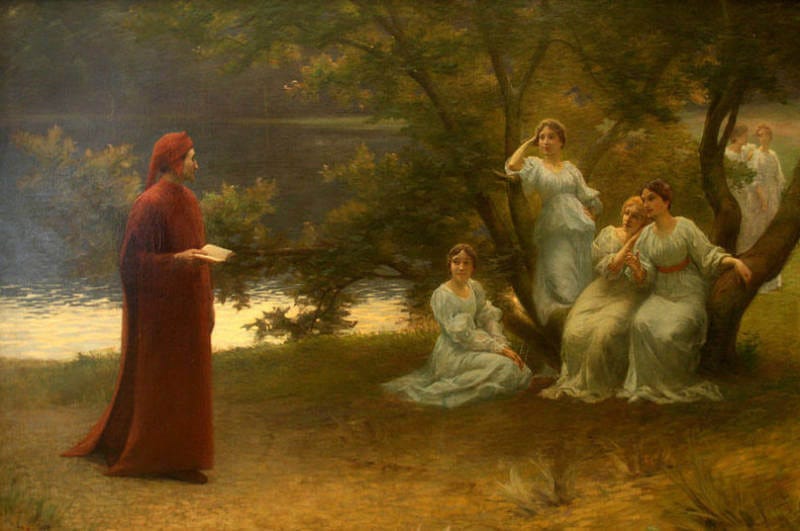
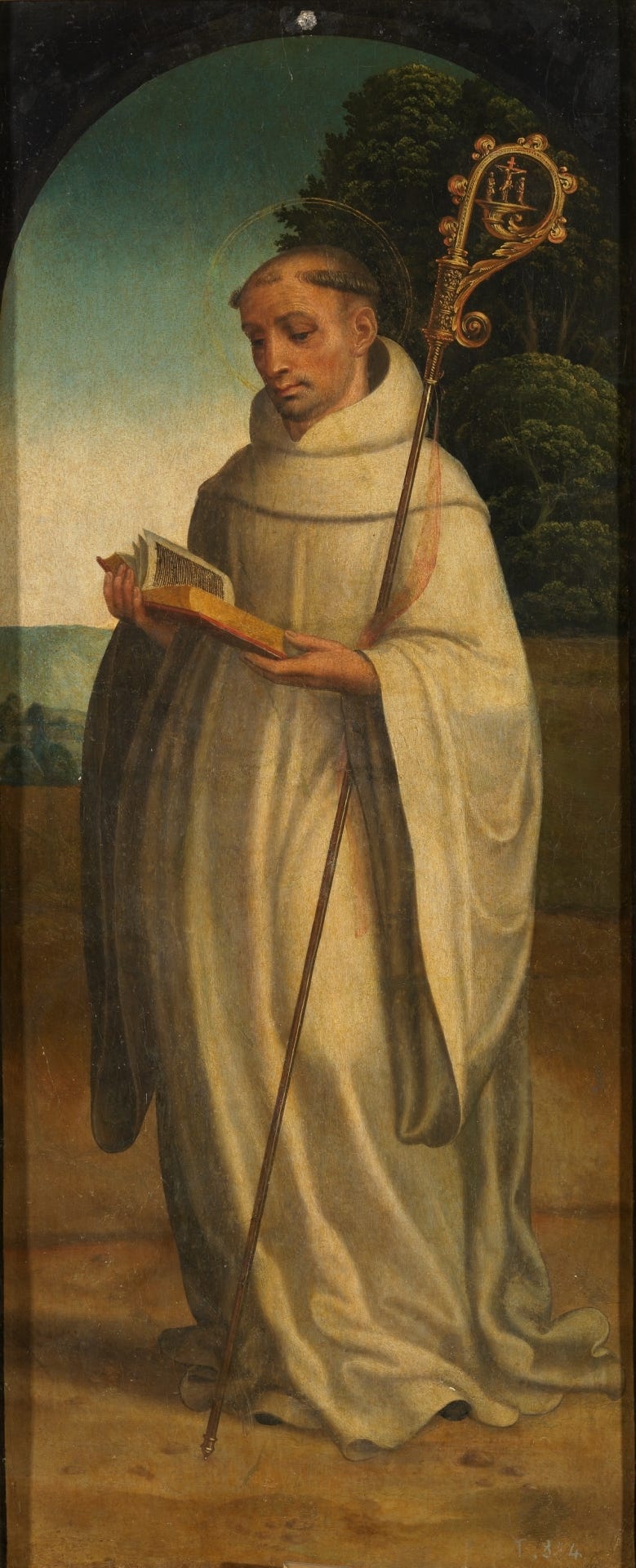
The elder who had presented himself was St. Bernard of Clairvaux, a contemplative monk who had been the abbot of the Clairvaux monastery, although as yet unnamed.
Although Beatrice can take him no further, for his final vision Dante still needs the guidance of one who can lead him onwards in contemplation and can implore grace for the ultimate boon. St. Bernard, the type of the mystical contemplative, is chosen for this role. He is not only the image of contemplation; in his literal sense, he is one who has himself seen God in the first life, and, since he will implore the Virgin to intercede so that Dante too may share this vision, his devotion to the Mother of God has both a literal and an allegorical appropriateness.3
Dante asked where Beatrice had gone, and St. Bernard directed his gaze up into the petals of the Celestial Rose, where Beatrice sat in the third circle of petals down from the top. The top tier held the Virgin Mary herself, the second tier, Eve, and Beatrice shared the third tier with Rachel, the contemplative, whom we met contrasted with her active sister Leah in the seventh terrace of Purgatorio.
Beatrice, who had guided by reflected light, is now seen (as is the whole rose) by that same kind of light. The wayfarer does not attempt, as yet, to see God directly, by the light of glory, this experience being reserved for the last canto and the very end.4
Although the distance between Dante and those edges of the Rose were as far away from each other as the depth of the ocean was to the clouds in the sky, still he saw her clearly and without obstruction. He began a speech to Beatrice, like a final address, a hymn of praise for this, their journey; that from the beginning, it was she that drew him forward, continuing on through every step of the way. He shifted the very form of words that he used in this address, going from the formal voi to the familiar tu. He praised her for drawing him upward to beatitude, and prayed that he would stay true to what she had inspired in him, that he may rise so far after his earthly life was complete.
You drew me out from slavery to freedom
by all those paths, by all those means that were
within your power. Do, in me, preserve
your generosity, so that my soul,
which you have healed, when it is set loose from
my body, be a soul that you will welcome.
xxxi.85-90
The shift clearly signals something else, namely the fact that Beatrice is no longer the guide (with a burden of allegorical meaning) but that, as she has taken her seat among the blessed, she is now seen as the individual historical personage, or the immortal individual soul, as she sits in eternal beatitude.5
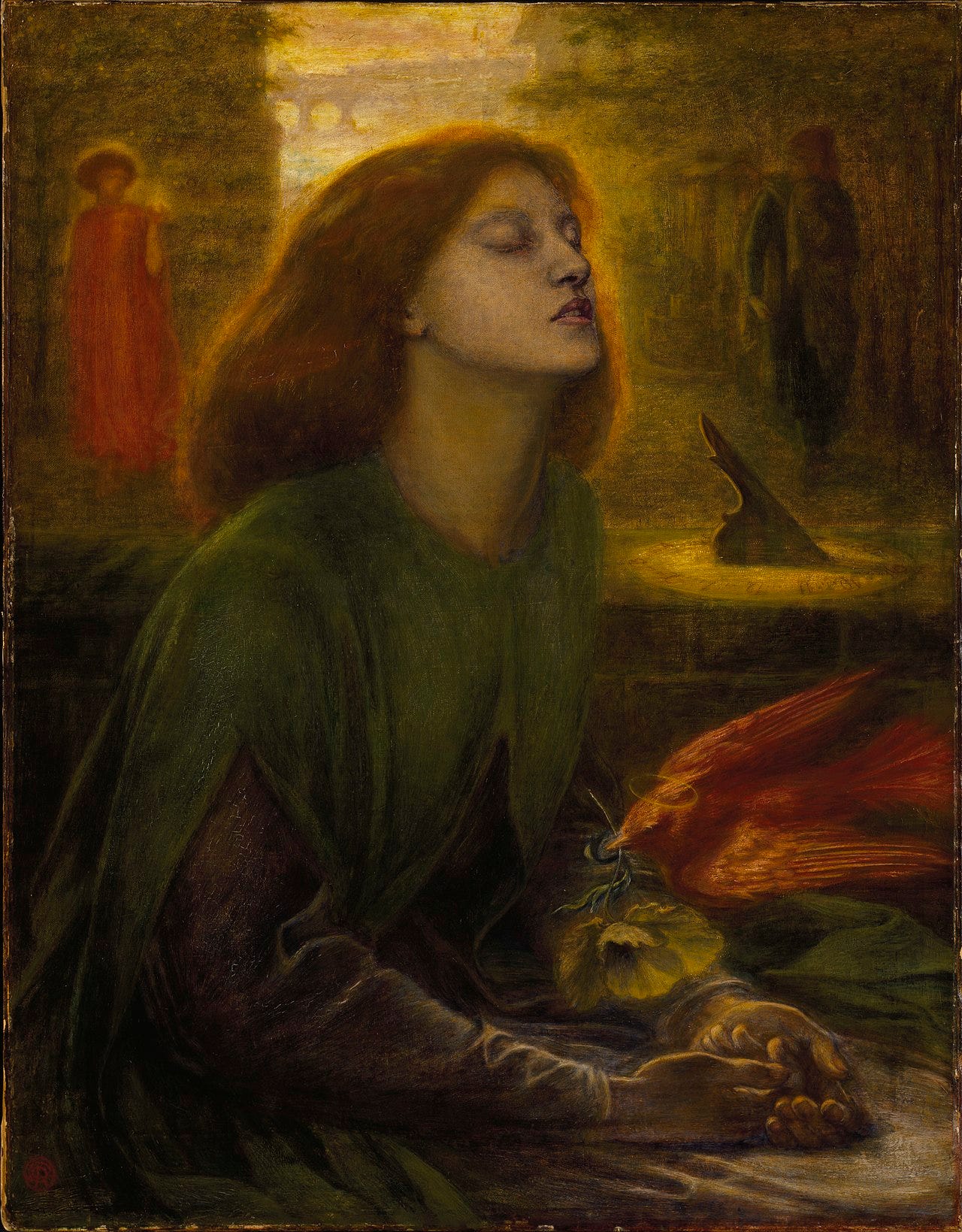
She looked down at Dante from her place in the Rose, and then turned to gaze once again upon the Light of God. Bernard spoke again; he was there to help Dante with the final moments of purification, so that he might see the final vision. By looking round the Rose, preparing his sight for the light of glory, Dante would be more prepared to see the highest.
Bernard finally named himself, he whose love and servitude for the Virgin Mary were at the forefront of his whole life, and whose beatitude had stemmed from that deep contemplation. Dante looked at him again with the eyes of a pilgrim, as one who had come to see the sacred shroud of Veronica—a cloth which held the imprint of the image of Christ on it, from the day she had offered to wipe his face as he carried the cross to the crucifixion. That pilgrim on earth would look with amazement at Christ’s image; Dante looked in just such amazement at St. Bernard, wondering to himself how incredible it was that he was seeing the famous figure he had heard about for so long.
The question was raised by theologians as to whether St. Bernard, in his contemplative life, had seen God in His essence. Dante evidently believes that he had, in fact, experienced immediate vision of the divine Being, and this belief largely accounts for Dante’s awe on beholding him; as St. Veronica’s veil was imprinted with Christ’s features, so St. Bernard’s countenance had envisaged God.6
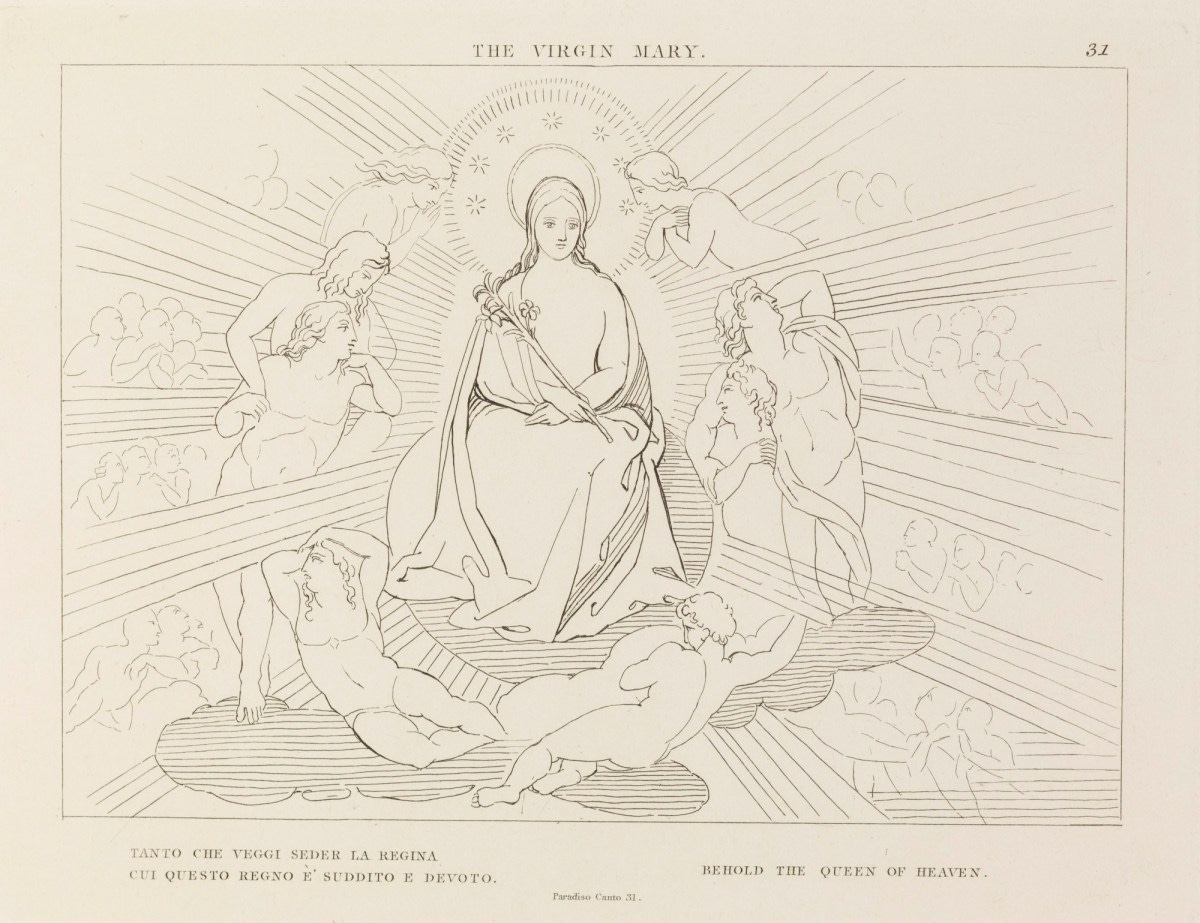
Bernard directed Dante’s glance not to himself, which would not accomplish the final goal, but above, to the Virgin Mary, on her seat and the top and center of the Rose, who shone with a light that was brighter than anything else round it:
I lifted up my eyes; and as, at morning,
the eastern side of the horizon shows
more splendor than the side where the sun sets,
so, as if climbing with my eyes from valley
to summit, I saw one part of the farthest
rank of the Rose more bright than all the rest.
xxxi.118-123
As high above him as the sun at noon, she shone. She shone like the red and gold standard, the Oriflamme, granted to France by the Angel Gabriel in the days of old. Around her flew all the angelic beings of the heavens, in the perfect dance and pageant of the highest of the high.
Bernard turned his gaze to match Dante’s, and they both basked in the sight.

💭 Philosophical Exercises
We do not entirely know how we mature as we grow up.
Maturity does not arrive all at once, nor does it follow a clear rulebook. It reveals itself through subtle shifts in how we relate to the world and to those who guide us through it.
When we are children and find ourselves in an unfamiliar place — a shop, a crowded street — we instinctively stay close to our parents. The world feels too large, too confusing, too unpredictable. We rely on them not only for protection, but for interpretation.
Paradiso XXXI opens with Dante still overwhelmed by the vision of the white Rose. The sheer scale of what he sees exceeds any single point of focus. His gaze moves, but it has not yet settled into order.
This is very much our state in the Inferno. There, Dante cannot afford to lose sight of Virgil. The landscape is overwhelming, disorienting, and hostile. Without Virgil constantly beside him, the journey would collapse into fear. Guidance at this stage is parental: it must be immediate, protective, and ever-present.
As we grow, something begins to change. We slowly become capable of moving away from our parents, of venturing into unknown spaces on our own. We still look back from time to time — not out of panic, but for reassurance.
I believe that this is precisely the role Beatrice plays once she enters Dante’s journey. A new level of maturity has been reached. Dante no longer needs to be guided step by step. His way of seeing has changed. He can move forward on his own, and yet it still comforts him to know that Beatrice is there — that if something escapes him, there is a gaze through which he can understand.
Beatrice does not merely accompany Dante; she reflects the divine order in a form he can bear. She mediates vision. She protects him from being blinded by what he is not yet ready to see directly.
At this stage of our journey, Dante explicitly says that he has grasped “the general form of Paradise.” Nothing has yet been fixed in detail, but the whole is already present to him.
But in Paradiso XXXI, Dante crosses a final threshold. He turns to speak to Beatrice — and she is no longer beside him.
It is the threshold of no longer needing a parent in an unknown place. No longer needing to turn back for explanation or comfort. When Dante turns around and does not see Beatrice, he is not distressed. He is not afraid. He is curious.
The line is strikingly calm: “Uno intendea, e altro mi rispuose.” He expects one voice, but another answered. With no panic after it.
This detail matters enormously. Fear has disappeared. Dependency has loosened. Dante can now see, and he is responsible for his own vision — in the same way that a mature person is responsible for how they face the world.
At this moment, Saint Bernard appears.
Bernard does not introduce himself dramatically. He simply answers. His presence feels functional, not emotional.
I.
The best way I can explain his role is by turning to an experience from my own life — my time at a Russian school.
Every quarter, we were taken on compulsory visits to museums and galleries. Once, at the Tretyakov Gallery, my school’s art teacher was guiding us through the halls. His explanations drained all life from the paintings. Dates, names, classifications — everything except meaning. I wrote about that tour in my piece ‘The Art of Teaching’.
But the brief version is this: during one of these boring tours, I escaped. And almost accidentally, I found myself standing before a painting by Aivazovsky.
I stood there. I looked.
For the first time, I grasped a painting as a whole. Not through facts. Not through explanation. But through direct perception.
Like Dante, I stood captivated, perceiving every stroke that Aivazovsky made, the whole of the painting pulled me in.
Then a woman approached me, who turned out to be one of the leading art historians in Russia, though I didn’t know it at the time.
She did not explain the painting. She did not interrupt my experience. She could see that I had already understood something essential.
Her role was similar to Bernard. It was to guide my attention.
She gently directed my attention to parts of the painting my gaze had not yet reached. She pointed, not to instruct, but to expand my vision.
My boring and annoying teacher would have told me the exact meaning of the painting; this lovely lady however, did the reverse. Instead of telling me what to think, she asked me to think for myself.
She was training my vision, in the same manner as Bernard repeatedly tells Dante where to look.
He redirects his gaze upward, toward Mary. He never explains what Dante sees — only how to approach seeing it.
This is exactly what Saint Bernard does for Dante and that was what the lovely lady did to me.
Virgil taught Dante how to survive.
Beatrice taught Dante how to understand.
Bernard teaches Dante how to attend.
He no longer needs explanations, interpretations, or reflections. What he needs now is orientation.
Saint Bernard does not stand between Dante and the divine. He does not soften the light. He does not translate meaning. He gives Dante a map.
“Let your eyes fly through this garden,” Bernard says. Vision is no longer mediated — it is trained.
Beatrice was a mirror.
Saint Bernard is a map.
And only once a person no longer needs a mirror can a map become useful.
Paradiso XXXI is therefore not about vision itself, but about readiness for vision. It is the canto in which Dante learns the final discipline before the ultimate sight: not interpretation, not protection, but attention.

This Week’s Sinners and Virtuous 🎭
(Themes, Quotes, Terms and Characters)
I. Beatrice’s Proper Place
Do you remember how attached Dante was to Virgil? We know it was necessary, but Dante’s entire attention was tied to Virgil. The attachment to Beatrice was different in its nature, and yet there was a dependence.
In this canto however, we can see that Beatrice does not disappear as Virgil, and yet she has her “place”. Carl Jung would have said that she has been ‘integrated’ into psyche, became a coherent whole of it.
Dante’s attention now is fully his. It no longer is focused on Virgil or Beatrice. His vision is his own.
I find this beautiful.
II. Historical Continuity
The quote below shows us that even in Paradiso we are tied to our roots. Dante’s connection to Florence, to its history, to the events that brought his exile are present even in a place where one would think they would disappear. We are united with history, and are history’s inseparable part.
Quotes 🖋️
(The ones I keep in my journal as reminders of eternal wisdom):
If the Barbarians, when they came from
a region that is covered every day
by Helice, who wheels with her loved son,

were, seeing Rome and her vast works, struck dumb
(when, of all mortal things, the Lateran
was the most eminent), then what amazement

must have filled me when I to the divine
came from the human, to eternity
from time, and to a people just and sane

from Florence came! And certainly, between
the wonder and the joy, it must have been
welcome to me to hear and speak nothing.

And as a pilgrim, in the temple he
had vowed to reach, renews himself—he looks
and hopes he can describe what it was like—

so did I journey through the living light,
guiding my eyes, from rank to rank, along
a path now up, now down, now circling round.

~ lines 31- 48, Paradiso, Canto XXX

Charles S. Singleton, Commentary on Paradiso 511
Dorothy L. Sayers, Paradise 332
Sayers 331
Singleton 519
Singleton 520
Sayers 333
“He blesses the boys as they stand in line
The smell of gun grease
And the bayonets they shine
He's there to help them all that he can
To make them feel wanted he's a good holy man…
He mumbles a prayer and it ends with a smile
The order is given
They move down the line
But he'll stay behind and he'll meditate…”
— “Sky pilot,” Eric Bourdan and the Animals, 1968
TL;DR: Saint Bernard has baggage.
I get it, I really do: Canto XXXI is about saintly function, not saintly merit. But I’m still going to state my objections to Bernard. Dante’s choosing him for teleological fitness, not virtue; however, I can’t separate the Saint from the contradiction of his blessing the disastrous Second Crusade, recruiting and motivating Crusaders, but then exempting himself and all his fellow clergymen from the sword-wielding “dirty work” (and the catastrophic failure of the enterprise). While Dante’s silence about Bernard's martial cheerleading is not surprising, neither is it exculpatory; he was well aware of the Saint’s reputation, but his veneration for Bernard prioritized spiritual and mystical contributions over controversies surrounding Bernard’s martial legacy. Dante, in essence, renders the martial matter moot; in the Empyrean, such classifications no longer pertain.
I’m aware that the Saint’s actions weren’t out of the norm by medieval standards; Church doctrine established clear functional differentiation between warriors and clergy. That said, there were plenty of crusaders who grumbled about “fat abbots” preaching holy wars. Bernard gave warrior-monks like the Templars their theological legitimacy by authoring De Laude Novae Militiae (In Praise of the New Knighthood), which exalted Templar virtues; it was, in essence, propaganda designed to convince knights to join the Order. It served as an intellectual charter for militia Christi and was the most concentrated theological defense of holy violence produced during the Middle Ages.
Lest we forget — the only ancestor Dante meets in the Commedia, his great-great-grandfather Cacciaguida degli Elisei, followed Emperor Conrad III on the Second Crusade, was knighted for valor, and died fighting in the Holy Land. Dante may have embellished Cacciaguida’s tale, but I still would have held a family grudge against the chief ecclesiastical cheerleader (the Honey-Sweet Doctor, or“Doctor Mellifluus”) for Cacciaguida’s death (which is why Dante’s in Paradiso and I’m not).
I don’t see a problem, in the context of the era’s threats, with the strategic intent of crusading (stopping the depredations of the Saracens), but I reject the ecclesiastical rationale of clerics exempting themselves from the crusading ranks. While I’m not implying only combat participation legitimates moral reasoning about war, Bernard never did personally test his theology under arms; his commitment was rhetorical, pastoral, and institutional — without personal risk.
Bernard was though, according to James Brundage, “…understandably sensitive to issues raised by the role that monks played in recruiting crusade armies. Otto of Freising tells us that Bernard himself was reluctant to preach the Second Crusade, and refused to do so until the pope specifically commanded him. His hesitancy was perhaps grounded on the longstanding canonical prohibition of preaching by monks.” To be clear: he wasn’t troubled by the hypocrisy of sending tens of thousands of men to their death in an ill-planned Second Crusade; his scruple was procedural, not moral: he was troubled that monks had to preach.
He was so passionately committed to the crusading enterprise that even after the collapse of the Second Crusade, since Pope Eugenius III did not abandon the crusading ideal, Bernard still indicated a willingness to assist if commanded. However, no formal Third Crusade was proclaimed, and Bernard never again mounted anything resembling his investment in the Second Crusade.
He had entered the Second Crusade at the height of his prestige as Europe’s most famous preacher. Although his reputation suffered following the failure, he never fully accepted responsibility, nor did he fundamentally retract the theology that made the debacle possible. He blamed failure on the sins and moral failings of the crusaders themselves; it was their greed, immorality, disunity, and lack of piety, rather than any flaw in the enterprise, or divine disapproval of the idea. In his De Consideratione (Five Books on Consideration)(3), he explicitly describes himself as a “shield” protecting God from the “scurrilous tongues of detractors” and the “poisoned darts of blasphemers.” He argues that attacks on him (for the crusade’s failure) are indirect assaults on divine will, since the enterprise was holy and undertaken in obedience. I think he hid behind institutional absolutism. Sadly, it’s no surprise the Church shielded him from criticism: it acted out of institutional self-preservation, and because, for them, Bernard himself was too big to fail.
Even conceding 12th century ethics and logic, there were critics at the time that saw his retrospective rationalization as a brazen theological dodge. The failure of the Second Crusade was not due to impiety, but rather to military incompetence in the form of catastrophic strategic ignorance, disastrous leadership, ignoring key intelligence, infighting, and overconfidence. Yet despite censure and the blow to Bernard’s prestige, his influence remained; he was swiftly canonized (1174), and later named a Doctor of the Church (1830). I don’t care how the Church revered (or covered for) him; God’s providence does not erase agency. He’s not my choice for a capstone guide. But then I’m a retired soldier, not a poet.
I’m willing to accept, in the interest of a poetic truce, that he believed the exemption for clerics was for doctrinal consistency rather than personal convenience, and that his anguish over the failure was both sincere and instructive. Bernard, now a humbled contemplative, does not just replace Beatrice; he changes the mode from explanation to petition. She’s exhausted theology and teaching; Dante needs a guide to propel him into direct, wordless union with God. He recalibrated and repurposed Bernard, who clearly may not have been the greatest saint, but performed the right function at the right time, mediating, through his prayerful intercession, Dante’s reception by God. Bernard demonstrated for Dante that failure is not the final word, and God will prove that even imperfect saints and exiled and embittered poets are redeemable.
Bernard wrote “De Consideratione” (Five Books on Consideration) for Eugenius III in the wake of the collapse of the Second Crusade and its severe blow to papal prestige, and under mounting criticism about whether he, the most influential preacher in Christendom, had misjudged God’s will. The work is more theodicy and self-justification than an admission of failure; he acknowledged anguish and shame — but not error. However incomplete the self-critique might be, it turned him from overconfidence in human plans to interior discernment, and that’s what piqued Dante’s poetic and teleological interest. Bernard wrote that popes should privilege “consideratio” (contemplative discernment), including self-knowledge, disciplined interior reflection, and resistance to vanity and political intoxication. There’s Dante’s selection criteria in a nutshell: Bernard is now a chastened master of humble contemplation.