
Ecstasy: Standing Outside Oneself
(Paradiso, Canto XXIII): The Vision of Christ, preparedness of the mind


Welcome to Dante Read-Along! ✨
(If this post appears truncated in your inbox you can read it on the web by clicking here. )
Welcome to Dante Book Club, where you and I descend into Hell and Purgatory to be able to ascend to Paradise. Our guide in Paradise is Beatrice, and in this twenty-third Canto, Dante and Beatrice have a vision of the light of Christ. You can find the main page of the read-along right here, reading schedule here, and the list of chat threads here.
In each post you can find a brief summary of the canto, philosophical exercises that you can draw from it, themes, character, and symbolism explanations.
All the wonderful illustrations are done specially for the Dante Read-Along by the one and only Luana Montebello.

This Week’s Circle ⭕️
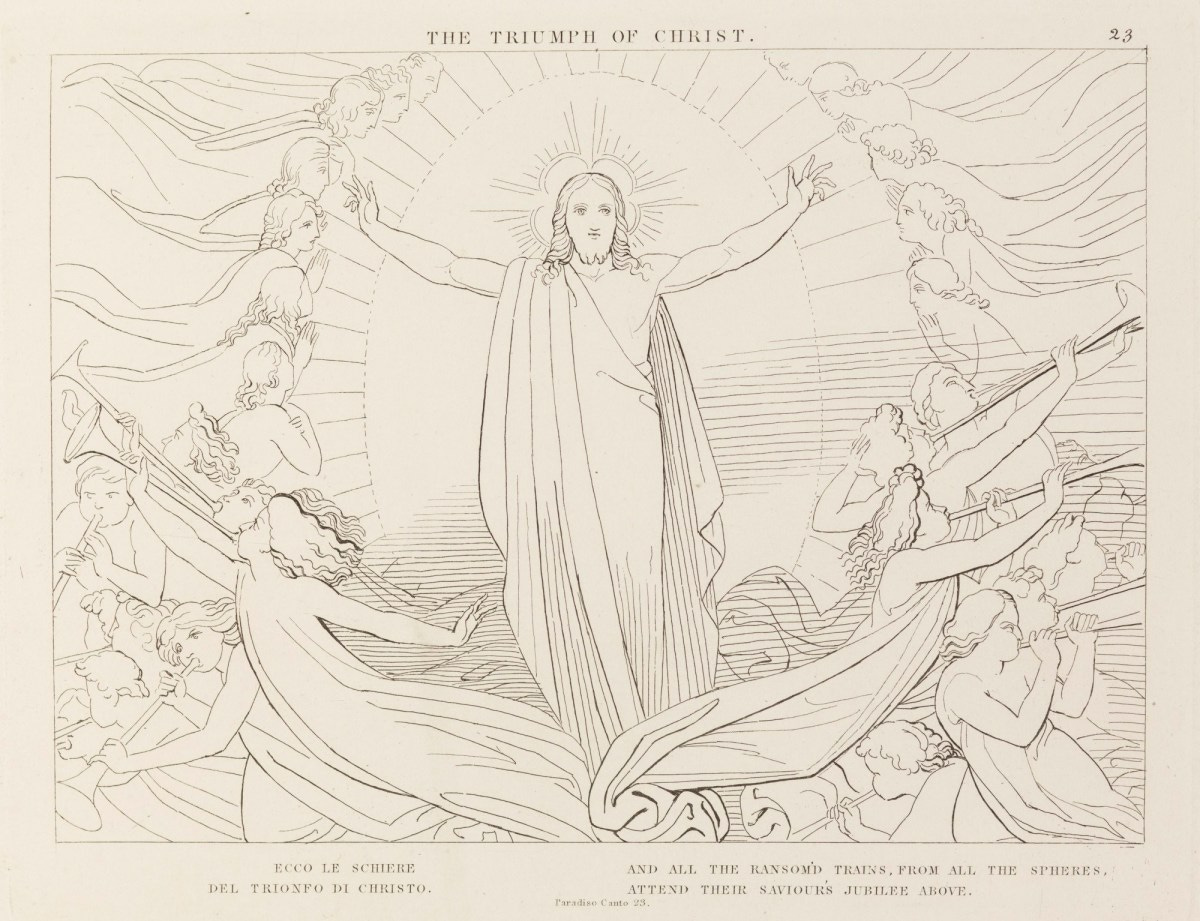
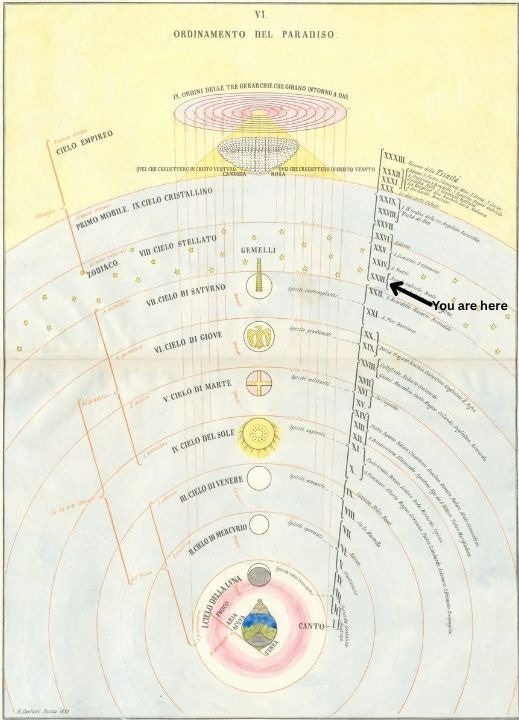
The Eighth Celestial Realm of the Fixed Stars - Beatrice gazes upward - The Vision of the descending light of Christ - The radiance of Beatrice’s smile and of the heavenly light - Dante’s illumination - The crowning of the Virgin Mary - The ascension of Christ and Mary to the Empyrean - The souls of the Fixed Stars sing praise.

Canto XXIII Summary:
In the opening of this visionary canto, filled with the lights and glory indicative of the Empyrean realm to come, Dante opened with the imagery of a bird waiting eagerly through the dark night, settled by her sweet chicks, face upturned in anticipation of the coming dawn. Beatrice stood thus, prepared for the sight which was about to greet them as they rested in the realm of the fixed stars, after the ascent up the divine ladder from the celestial realm of Saturn.
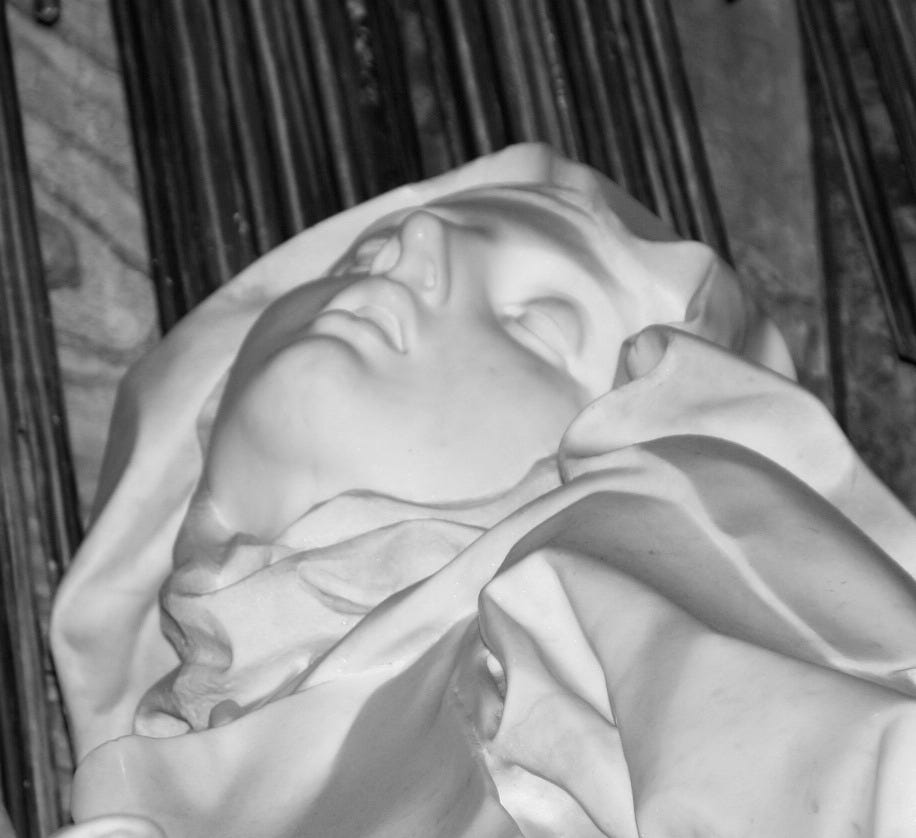
She looked not toward any horizon, as one would expect with a coming dawn, but at the meridian, the zenith, the crown of the sky; her expectant gaze filled Dante with longing as well, a longing that brought satisfaction rather than emptiness. Quickly his longing was fulfilled, for the heavens lightened as if the dawn were breaking far above them. The vision had begun.
And Beatrice said: “There you see the troops
of the triumphant Christ—and all the fruits
ingathered from the turning of these spheres!”
xxiii.19-21
Finally we are told what comes, though the whole scene is entirely symbolical, as the reader must realize. Christ will now appear as a sun illuminating many stars, and the action of the canto will develop from and through such symbolism. Here is the host of the blessed who were, so to speak, ‘harvested’ out of time, the fruit gathered in from the turning of the spheres, a turning which is the very image of time, for it determines time for mortals on earth.1
Where before we beheld a single planet in each sphere, here that has changed into the multitude of stars, each a soul, the beginning of the hosts of heaven.
Dante now momentarily anticipates the final cantos of the poem when he experiences a vision of Christ in triumph surrounded by all the souls of the Church Triumphant in Heaven, who will finally be seen, face to face, in the Empyrean. For the moment, however, this vision remains indescribable. Dante is still a member of the Church Militant on earth.2
Beatrice’s face, as she directed him to this unfolding vision, shone in fiery brightness, so much so that he did not even attempt to describe it. Her radiant bearing matched the glorious light that grew ever brighter above him, and just as the goddess Diana in her triple form of the moon, the hunt, and death, would shine among the nymph like stars around her, back in sight of earth, this light was a thousand times brighter and more magnificent:
Like Trivia—at the full moon in clear skies—
smiling among the everlasting nymphs
who decorate all reaches of the sky,
I saw a sun above a thousand lamps;
it kindled all of them as does our sun
kindle the sights above us here on earth.
xxiii.25-30
Such was its light that it was not only that ineffable brightness lacking in solidity, but the light itself held substance of its own separate existence that enveloped him and blinded him. In his heart he cried out to Beatrice, who defined this substance as the very source of Wisdom and Power animating everything, opening the way to heaven that had been closed since the sins of Adam.
From Adams’ sin to the Advent of Christ, the way to Heaven was closed. Even the virtuous who believed in Him went to Limbo to await His “opening of the way.” And there in Limbo the long desire for His coming was felt, as it was on earth among those who believed in Him as the Redeemer.3
The effect of the vision on Dante crescendoed into a moment of bursting light within his very mind, a transformative moment of becoming the light within himself which he visioned outside of him, an ultimate moment of oneness that we have waited for with anticipation:
Even as lightning breaking from a cloud,
expanding so that it cannot be pent,
against its nature, down to earth, descends,
so did my mind, confronted by that feast,
expand; and it was carried past itself—
what it became, it cannot recollect.
xxiii.40-45
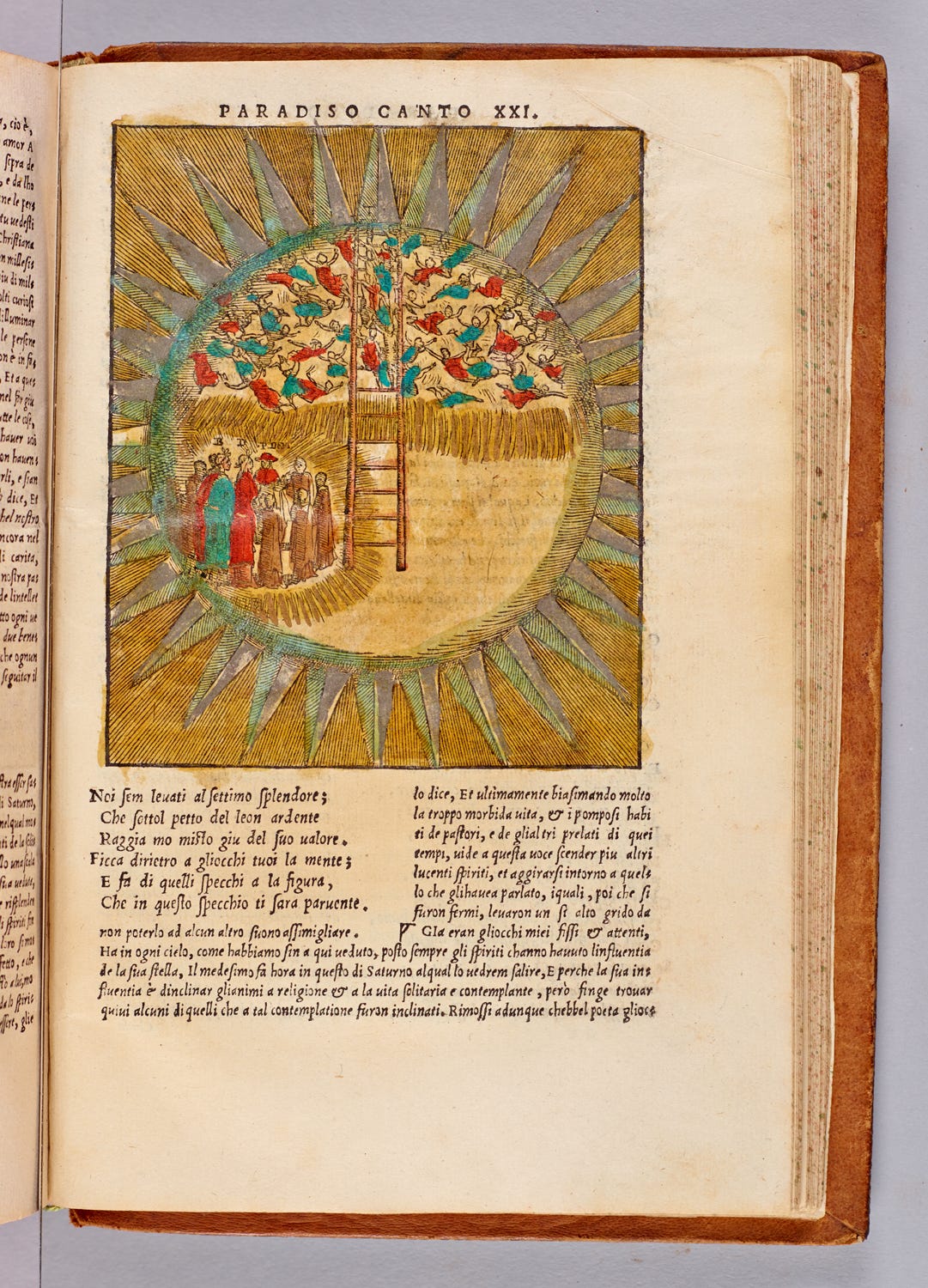
Such moments are described by the mystics as Cosmic Consciousness, enlightenment, or ecstasy; yet in gazing upon the infinite, there is no end to the absorption of that light. The vision has tempered him, prepared him, awakened him to be able to gaze upon the face of Beatrice as he has so longed to do; her brightness having become so great that he had not looked upon her face since entering Saturn, but now he was able to endure it.
Open your eyes and see what I now am;
the things you witnessed will have made you strong
enough to bear the power of my smile.
xxiii.46-48
Dante had new eyes; he was as one who had awakened from a dream that he did not even know was a dream. The songs of all the poets inspired by the Muse of sacred poetry—Polyhymnia—and her sisters, throughout all the ages, that had nurtured and fattened the poets of old with their rich nourishment, could not touch in words the radiance of her smile as he gazed upon it.
In order to speak of what would come after this moment of illumination, Dante had to leap from mortal understanding to something much more divine, and the prospect brought a tremble of trepidation to his task; yet he carried on, not to be dissuaded. He compared his attempt to a tiny boat in a great and wide sea; we know that he accomplished his goal.
Beatrice turned Dante’s gaze to sights more wondrous than her own radiance; the blooming of the garden of the blessed was before them, and she pointed to the appearance of the Virgin Mary and to the apostles, she the mystic rose and they the lilies:
Why are you so enraptured by my face
as to deny your eyes the sight of that
fair garden blossoming beneath Christ’s rays?
The Rose in which the Word of God became
flesh grows within that garden; there—the lilies
whose fragrance let men find the righteous way.
xxiii.70-75
Dante moved his gaze as the light of Christ slowly rose higher again, dimming the brightness that had shone down on them, and leaving behind it the ray of light as through a cloud the many glowing souls who remained, anchored by the brightest of the flames, the Virgin Mary, she whom Dante invoked morning and evening back on earth:
The name of that fair flower which I always
invoke, at morning and at evening, drew
my mind completely to the greatest flame.
xxiii.88-90
Her light was imprinted upon his eyes; not only her light, but another light descended from above, the angel Gabriel of the annunciation, to crown her with a garland of light in a ritualistic celebration that we can imagine plays out constantly in the great pageant of the heavens. The beautiful music that emanated from Gabriel was so heavenly that the loveliest music on earth would be only as a rumble of thunder or a crash of lightning.
I am angelic love who wheel around
that high gladness inspired by the womb
that was the dwelling place of our Desire;
so shall I circle, Lady of Heaven, until
you, following your Son, have made that sphere
supreme, still more divine by entering it.
xxiii.103-108
He looked above him to the ninth sphere of the Primum Mobile, that “royal mantle” of the eight spheres below it. As Mary rose up to it, it was so far distant above them that he lost sight of her before she reached that high heaven. The Primum Mobile was the quickest moving of all the spheres, the Prime Mover:
However, outside of all these spheres, Catholics posit the Empyrean heaven, that is to say, the heaven of flame or the luminous heaven; and they assert that it is motionless by having within itself, with respect to each of its parts, all that its matter wants. This is the reason for the extremely rapid movement of the Prime Mover: through the exceedingly fervent desire of each part of the ninth heaven (which is right next to that one) to be united with each part of that most divine and tranquil heaven, it revolves within it with so much desire that its speed is practically incomprehensible.
Dante, Convivio II.iii.8-9
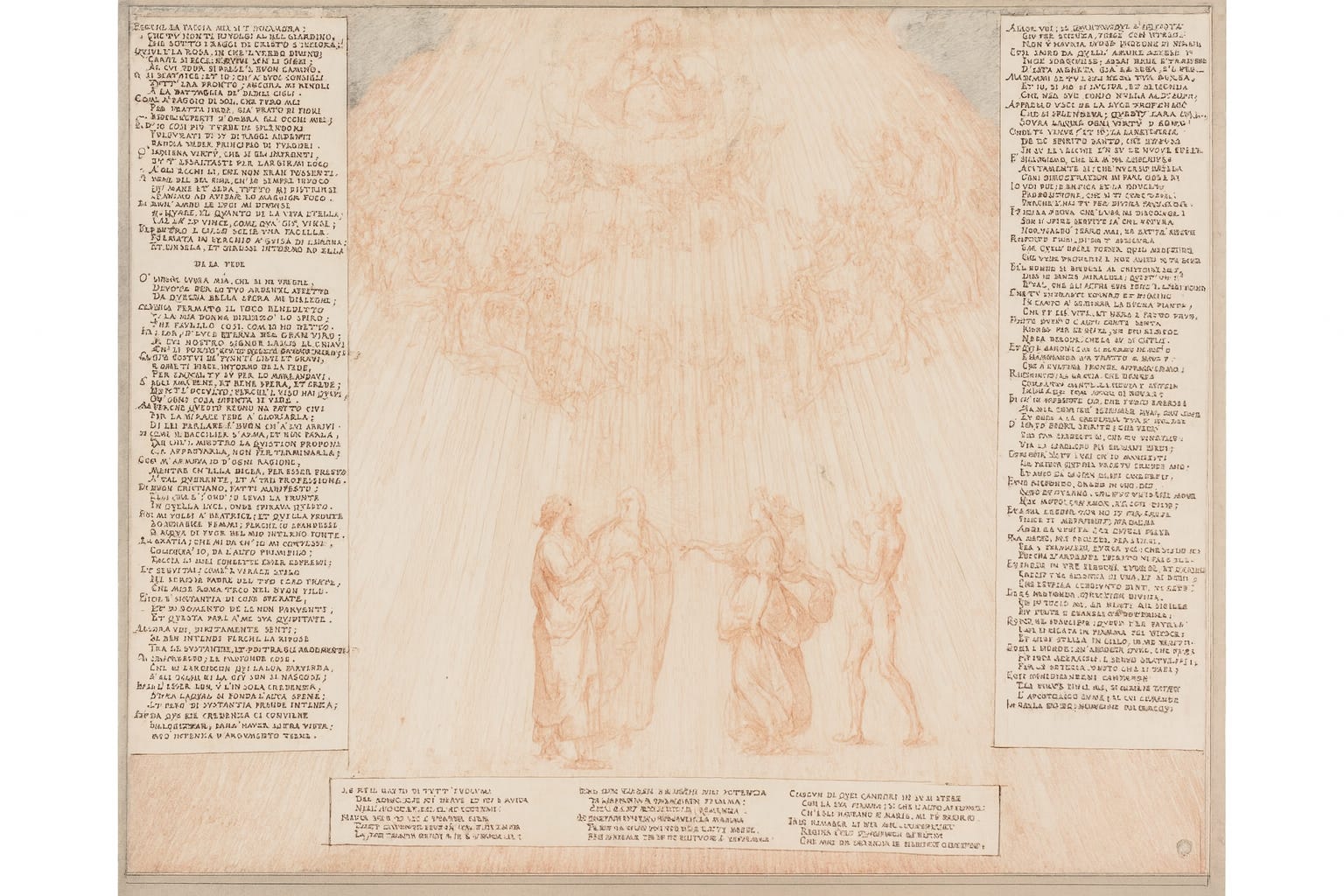
It should be remembered that the desire which the spheres have for the unmoved Mover is basically Aristotelian in conception. The very last verse of the whole poem will echo this doctrine. Moreover, in imagery that is to come the reader will see how this ninth heaven receives God’s light and power.4
With an innocent and wordless gesture infused with love and longing, the souls of the Fixed Stars reached their light toward Mary as she ascended above them, singing the hymn Regina Coeli, or the Queen of Heaven:
Rejoice, O Queen of heaven, alleluia,
For he whom thou deservesdst to bear, alleluia,
Hath risen, as he said, alleluia.
Pray to God for us, alleluia.
Rejoice and be glad, O Virgin Mary, alleluia.
For the Lord hath truly risen, alleluia.
The reaping of joy that Dante witnessed in this high heaven was the result of the seeds sown on earth, seeds of love and truth, of justice and nobility. As the tears of exile were bitter on earth even while upholding the true nature of the pure in heart, so were the joys of victory here in heaven.
Upon the rivers of Babylon, there we sat and wept: when we remembered Sion:
Psalm 136:1
They reap these benefits with the souls of the Prophets of the Old Testament and the Apostles of the New, and the keeper of the keys of the Kingdom, St. Peter.

💭 Philosophical Exercises
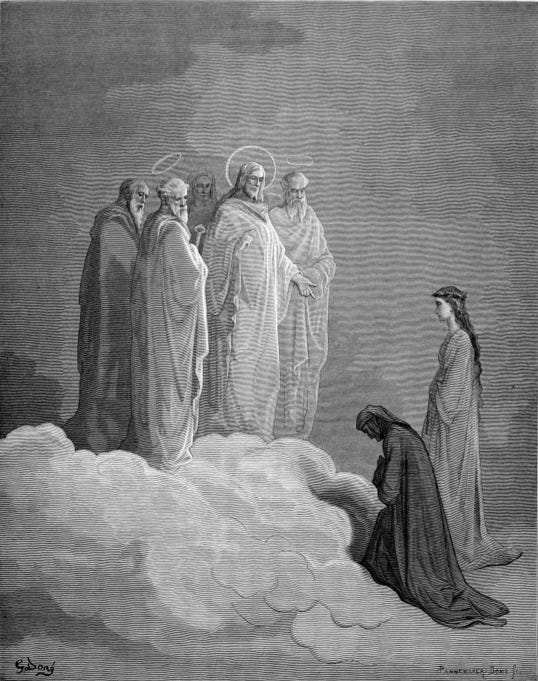
I have to confess to my dear reader that this was one of the hardest cantos in which to find a philosophical exercise, because Paradiso XXIII is so mystical. It has no plot in the usual sense; there is no conversation, no moral discourse, no visible path to follow. And yet something remarkable happens here: Dante crosses another threshold.
The thresholds of Inferno were visible and tangible, often terrifying; in Purgatorio, they were solemn and sacramental, guarded by angels or marked by figures who helped the pilgrim ascend. But in Paradiso XXIII Dante crosses a threshold of a completely different kind. He moves from the planetary spheres, the last remnants of the cosmos still connected to the earth, into the higher, divine, mystical spheres. And it is here that he encounters Christ, the blinding source of all light.
What stands out to me is that this threshold is crossed through contemplation. Once again Dante shows us that contemplation is not a passive state, but an active power of the soul that allows us to grasp the strength of the divine.
It reminded me of a story some of my readers may know: the story of Thales of Miletus, the philosopher who was mocked by his fellow citizens.
They believed he spent his life contemplating because he was incapable of doing anything practical or useful. To prove them wrong, Thales used his knowledge of astronomy to predict that the next year would bring an unusually good olive harvest. Before anyone else understood what was coming, he rented all the olive presses in the region. And when the abundant harvest arrived, everyone had to come to him to rent the presses at a high price. Aristotle tells this story to show that Thales did not choose the contemplative life because he couldn’t succeed in the practical world, but because he preferred to devote himself to higher things.
I believe this fits perfectly with what we’ve seen in the previous canto. When Dante was asked to look back at the earth in Paradiso XXII — the reverse Orpheus moment we explored — the message was clear: the direction toward the divine must be voluntary. One must walk the earthly path, see it fully, and then freely turn toward something higher.
Contemplation is not an escape from the world, but the act of choosing the highest aim in the world.
II.
What is remarkable here is that even when fortified by grace, the human eye still strains to withstand the intensity of heavenly light. Up to this point in Paradiso, it seemed to us, from Canto to Canto, that Dante had finally reached the level at which he could grasp divine beauty and meaning. And yet, when the blinding light of Christ appears in Canto XXIII, we are reminded that contemplation always involves effort. It is not a passive vision. It is an active stretching of the soul.
Here we witness something essential about true contemplation: it requires that the self be exceeded. Dante experiences what the tradition calls ecstasy — literally ex-stasis, standing outside oneself. The meaning is that the true inner workings of the world, the reality behind appearances, can be perceived only when the self steps aside, when the soul slips beyond the boundaries of ordinary consciousness.
This naturally recalls Carl Jung’s idea of loosening and stripping away the ego in order to experience a deeper unity with the whole of being. I’ve noted many times that Dante’s Paradiso feels like an alchemical text, and I want to underline that here. Jung believed that the alchemists were struggling to express complex inner experiences — mystical illuminations, moments of union, encounters with the divine — in a symbolic language because ordinary speech is incapable of carrying them. When Dante tries to describe what it is like to witness the arrival of the divine light — to feel himself overwhelmed yet transformed, he is doing something similar. Jung would say that Dante is translating an inner, mystical event into a language of images, symbols, and poetic fractures.
This helps explain why, as Teodolinda Barolini beautifully shows, this canto operates through what she calls an anti-narrative mode. There is no clear linear sequence; even the visions of Christ are presented out of chronological order. Instead of a chain of events, the canto unfolds like a dream — coherent in meaning, but not obedient to time. It is driven by revelation, not by plot. The order is experiential, interior, symbolic.
And this brings to mind another idea, this one from the world of science and logic. In Jim Holt’s essay on Kurt Gödel — the remarkable logician whose theorems transformed mathematics — Holt recounts Gödel’s speculation that perhaps the events of the world do not unfold in time. Perhaps all events already exist, all at once, in a single totality. It is only our human brain, limited in its capacity, that forces reality into chronological sequence so that we can grasp it.
In a way, Dante dramatises this very insight in Canto XXIII. The visions come not in the order in which they historically happened, but in the order in which the soul can bear them. Dante’s consciousness is being drawn up into a reality where sequence breaks down, where meaning is no longer temporal, but eternal.

This Week’s Sinners and Virtuous 🎭
(Themes, Quotes, Terms and Characters)
I. The opening lines
The opening bird image shows contemplation as loving vigilance. A mother bird, awake before dawn, leaves the nest and fixes herself on the place where the sun will rise, eager to see her young and feed them.
This is Beatrice, and the soul, poised toward Christ’s coming: not drifting in abstraction, but burning with tender, alert expectation for the light.
Quotes 🖋️
(The ones I keep in my journal as reminders of eternal wisdom):
Here, under the high Son of God and Mary,
together with the ancient and the new
councils, he triumphs in his victory—

he who is keeper of the keys of glory.

~ lines 136--39, Paradiso, Canto XXIII

Charles S. Singleton, Commentary on the Paradiso 373
Robin Kirkpatrick, Paradiso 428
Singleton 375
Singleton 380
In Canto XXIII, we witness Dante being fortified with the spiritual and poetic courage needed to put divine vision to verse. He’s in a peculiar position: this is the last heaven that can be seen from earth, dividing the visible (Creation; the “dusty threshing ground”) from the invisible (the divine; the pure, unmediated essence of God in the Empyrean). The world he left (and will return to) is, as God’s Creation, inherently beautiful, but it is a “dusty threshing floor” full of violence, contradiction and paradox. He will have the herculean task of returning to it and arming mankind (as he himself said, “pro utilitate mundi—for the profit of the world”) with the knowledge to achieve spiritual equilibrium between the visible and invisible. But to ensure he is fully prepared to be God’s scribe, he must first be tested.
He does not know examinations are coming, but senses something significant is about to happen. There are tells scattered throughout XXIII: his faculties (vision, intellect, capacity) are strengthening, Beatrice’s manner is graver, he’s experiencing both ecstasy and intellectual clarity, and the rising pressure, weight, and solemnity suggest this is a hinge point in his spiritual ascent. Singleton describes it as “a moment of interior strengthening” and Alessandro Vellutello said “Dante is here lifted above his natural power.” After all, he’s still a probationer when it comes to his moral and spiritual capacity to bear the divine light.
Oscar Wilde said "Experience is the hardest kind of teacher. It gives you the test first and the lesson afterward". Even if he’s no longer inexperienced, the ever-ingenious Dante admits to being beset by limitations of human comprehension. Aldous Huxley said "Experience is not what happens to a man; it is what a man does with what happens to him." Dante brings what happened to him along on his ascent, but this is a grace-driven climb; experience is only meaningful when it is illuminated by divine light.
The good news is he is unselfconscious, unrehearsed, and receptive; the daunting news is that he will face, in the next sequence of cantos, a series of interrogations that will make the most difficult college entrance exam look like child’s play (Dante compared the coming interrogations to that of a medieval doctoral candidate). The examinations will confirm how fully grace operates in him; while he can’t be expelled, he will be judged on his degree of moral excellence. Imagine those stakes; it’s easy to understand why he’s a bit wobbly.
“Just so, that Heaven may be figured forth, my consecrated poem must make a leap, as a traveler leaps a crevice there on earth. My theme is massive, mortal shoulders frail for such a weight. What thoughtful man will blame me for trembling under it for fear I fail?”
What better intellectual inspiration for the coming test, though, than to be transformed by the brilliant light of Christ, and to have Beatrice and the Virgin Mary as role models and tutors? Seeing perfect, redeemed beings offers a source of immense resolve as he prepares to write his gospel of truth for the “profit of the world.”
Perhaps Pliny the Elder had the properly encouraging perspective for what’s coming: “How many things were impossible until they were actually done!” Canto XXIII confirms that accomplishing the impossible stems from divine empowerment, not human ingenuity.