


Welcome to Dante Read-Along! ✨
(If this post appears truncated in your inbox you can read it on the web by clicking here. )
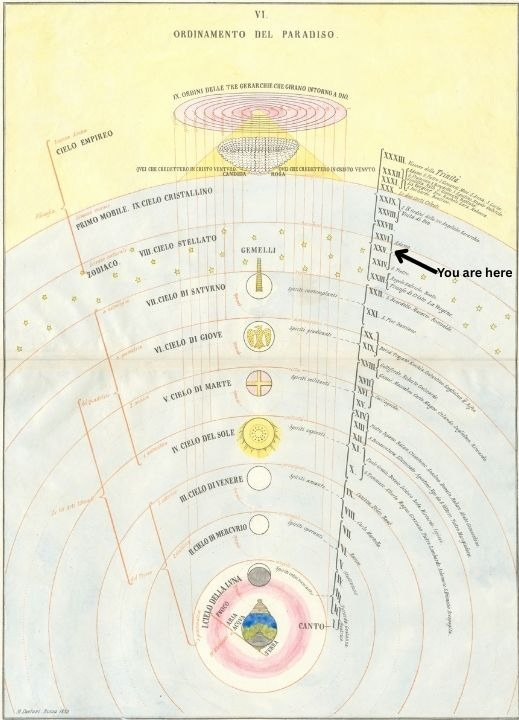
Welcome to Dante Book Club, where you and I descend into Hell and Purgatory to be able to ascend to Paradise. Our guide in Paradise is Beatrice, and in this twenty-fifth Canto, Dante is questioned on Hope by St. James. You can find the main page of the read-along right here, reading schedule here, and the list of chat threads here.
In each post you can find a brief summary of the canto, philosophical exercises that you can draw from it, themes, character, and symbolism explanations.
All the wonderful illustrations are done specially for the Dante Read-Along by the one and only Luana Montebello.

This Week’s Circle ⭕️
Celestial Sphere of the Fixed Stars, Continued - Dante’s desire for his hometown of Florence - The appearance of St. James - James questions Dante about Hope - Beatrice answers one of the questions for Dante - Dante gives the definition of Hope - St. John arrives from the circle of lights - Dante is blinded by the light.

Canto XXV Summary:
After St. Peter crowned Dante with light, his thoughts, in the opening of canto xxv, turned to his exile and the suffering he had endured while cast out of his beloved city of Florence; these thoughts came to him as he prayed that his magnum opus, the Divine Comedy, might grant him a return. He compared himself to a lamb within the safety of home that had been overtaken by wolves, and longed for his future, older self, to stand before the very spot he was baptized in the church of San Giovanni and be crowned with the poet’s laurel:
Because it was the pleasure of the citizens of that most beautiful and famous daughter of Rome, Florence, to banish me from her sweet breast—where I was born and bred right up to the peak of my life, and where, with her goodwill, I desire with all my heart to rest my weary spirit and to end the time allotted to me.
Dante, Convivio I.iii.4
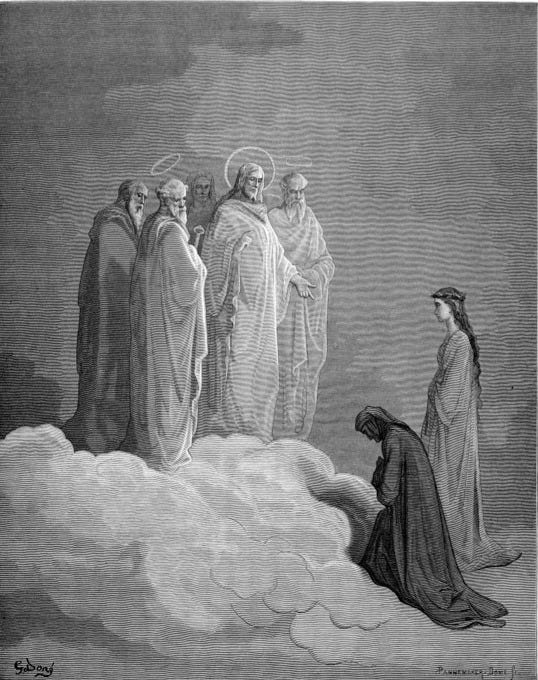
This sacred spot was where he had discovered that Faith which he had just defended to Peter in such detail. With this thought, Dante watched as from the brightest circle of lights—the same from which St. Peter had come, there in the eighth celestial sphere of the fixed stars—came another bright light toward them. Beatrice pointed out to Dante the soul that was arriving, identifying him by the town of his pilgrimage in Galicia; this was the Apostle James:
Son of the fisherman Zebedee and of Salome, and brother of John the Apostle and Evangelist, he was put to death by Herod Agrippa I shortly before the day of the Passover in 44. According to tradition, James preached the Gospel in Spain. He later returned to Jerusalem, and after his death his body was miraculously transferred to Santiago de Compostela, then the capital of Galicia. The relics of the saint were said to have been discovered in 835 by Theodomir, bishop of Iria, who was guided to the spot by a star, whence the name (Campus Stellae). Pilgrimages to the tomb of St. James at Santiago de Compostela were so frequent in the Middle Ages as to be second only to those to Rome itself.1
Now about that time Herod the king stretched forth his hands to vex certain of the church. And he killed James the brother of John with the sword.
Acts 12:1-2
Peter welcomed James with affection:
As when a dove alights near its companion,
and each unto the other, murmuring
and circling, offers its affections, so
did I see both those great and glorious
princes give greeting to each other, praising
the banquet that is offered them on high.
xxv.19-24
The brightness of their presence before Dante was so astounding that he was overcome and had to avert his eyes. Beatrice addressed James, indicating that after his examination on Faith, Dante was ready to defend the virtue of Hope, which James was uniquely perfect to examine. He was the allegorical representation of Hope, just as Peter was of Faith, and as we shall see, John was of Love.
James called Dante to lift his gaze back to the brightness of his visage, as he was in the very spot in which his sight would be prepared for even greater light:
Lift up your head, and be assured:
whatever comes here from the mortal world
has to be ripened in our radiance.
xxv.34-36
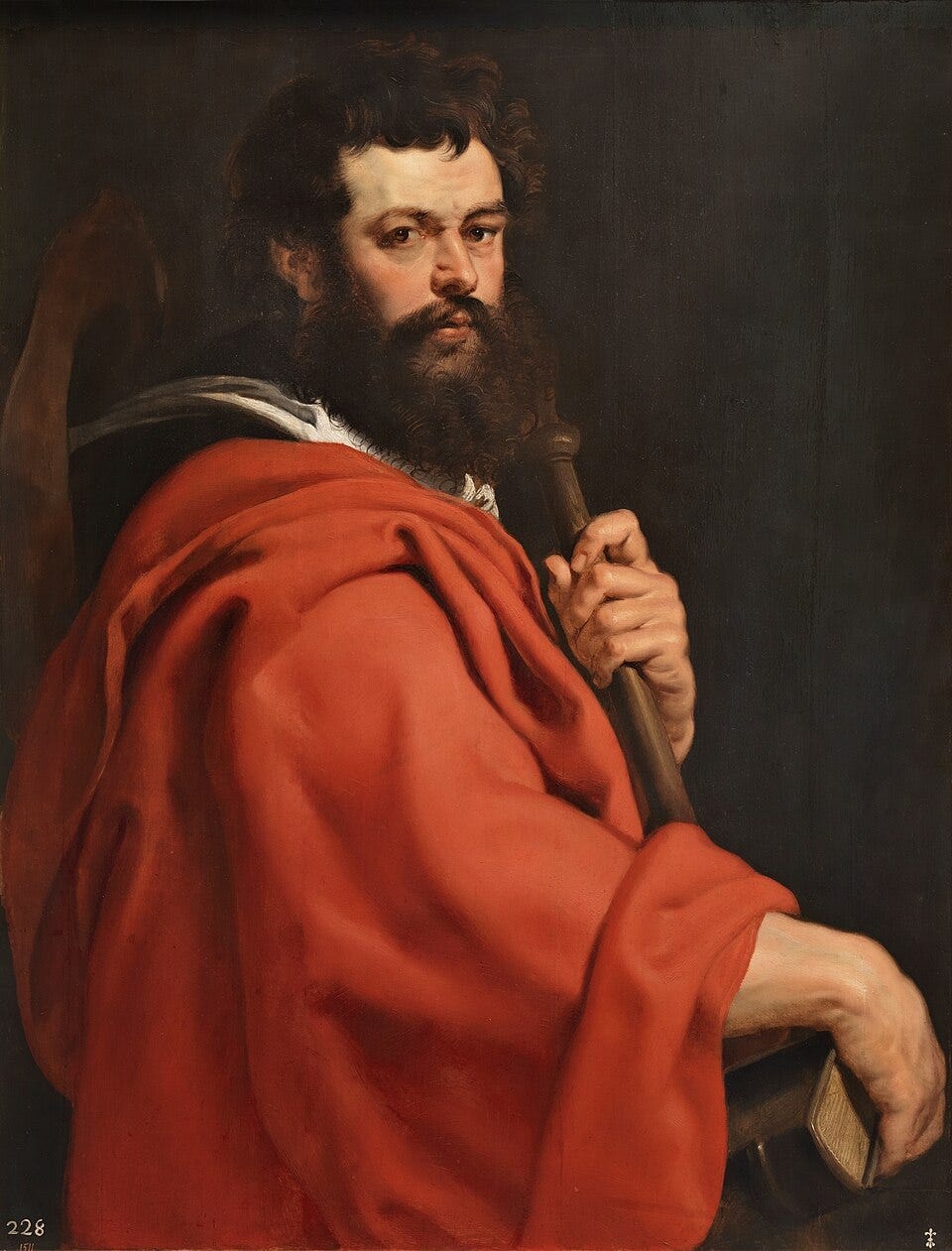
Being thus assured, Dante raised his eyes and gazed upon both James and Peter, and listened to the beginning of James’ speech. James announced the special dispensation that Dante had, to view the highest realms while still in a mortal body, and to express that story through his epic poetry, rekindling hope, which opened the door to love:
As hope arises from faith, so love arises from hope.2
And speaking of this theological virtue of Hope, James asked Dante to answer him three questions; to define what Hope was, how much of it unfolded within himself, and from what work he came upon receiving that virtue.
Beatrice, she who was like the wise Daedalus, crafting Dante’s path each step of their journey, replied for Dante, answering the second of James’ questions in a beautiful interlude between the asking and Dante’s telling. Imagine having to present before the very saints your understanding of the deepest intellectual designs!
Dante was an ideal example of the exemplar of Hope, Beatrice shared, as James would see in the unspoken mind of God in which all is imprinted, the proof of which was his enduring sense of justice that social and religious ills would be put to right, and his presence in that high realm.
Dante’s hope was undying, hope for mankind, for the Empire, for Italy, for Florence, for the regeneration of the Church, for the coming of a political leader, and hope, in the face of bitter disappointments, of his own honourable reinstatement in Florence. Above all, the Christian hope, arising from faith in God, was so strong in him that this great vision and mission had been granted him by grace that he might inspire others likewise to believe, hope, and love.3
Dante’s journey is his moral Exodus from enslavement in this sinful and corrupt world to the freedom of the heavenly Jerusalem.4
Beatrice concluded her thoughts, and left the other questions open for Dante to answer; for in having answered as she did, she saved him the embarrassment of self-praise. Just as before Peter, Dante felt ready to be examined by the master. He gave the definition of Hope in answer to James’ first question:
Hope is the certain expectation
of future glory; it is the result
of God’s grace and of merit we have earned.
xxv.67-69
Now hope is a certain expectation of future beatitude proceeding from God’s grace and antecedent merits. Without merits, to hope for something is not hope but presumption.
Peter Lombard, Sententiae III.xxvi.1
As Beatrice had already answered the second question, Dante next answered the third question posed by James, how Hope had come to him. It was inspired from many places, said Dante, from the scriptures and commentaries, those bright guiding stars of the past, but it was the Psalms of King David that truly inspired him:
This light has come to me from many stars;
but he who first instilled it in my heart
was the chief singer of the Sovereign Guide.
xxv.70-72
David had sung out with delight in his Divine Song of the Psalms, that those who knew God would put their hope in him; Dante saw the result of the wisdom of the Psalm and the wisdom of the Epistle of James as a fullness within himself, as an overflowing fountain which could go on to inspire others.
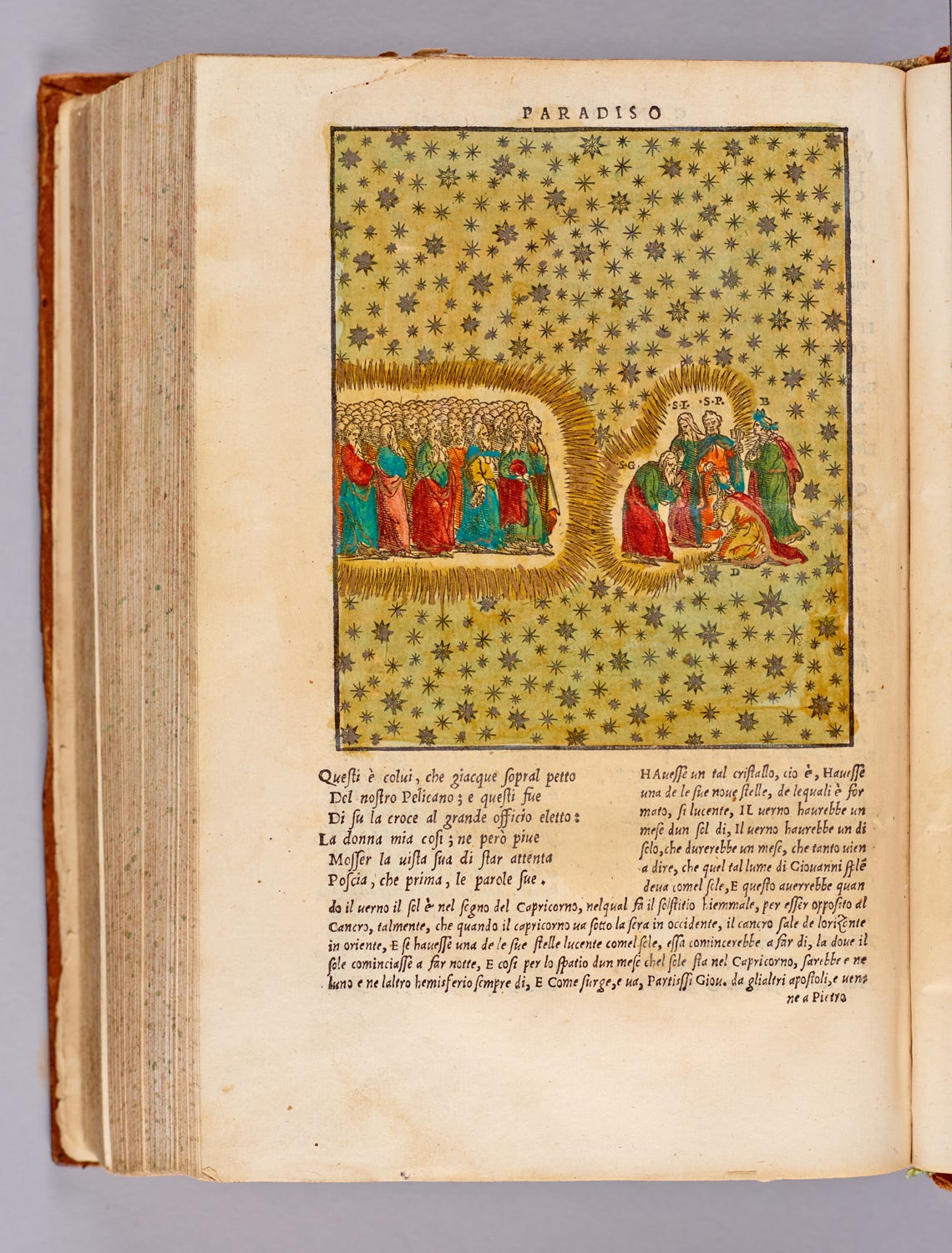
James’ inner light flashed in response; he had been filled with Hope even to the end of his life and martyrdom, and the love which was kindled by that Hope bid him to speak and ask a fourth question; “what hope has promised unto you” (87).
Dante had gained Hope from the scriptures, which promised attainment to heaven for those elect who followed the way; they would obtain the double garment of Isaiah, the glorified body unified with the purified soul. St. John, the third of the heavenly questioners, would make Isaiah’s words more clear in his book of Revelation, where he spoke of the elect in their white robes:
After this I beheld, and, lo, a great multitude, which no man could number, of all nations, and kindreds, and people, and tongues, stood before the throne, and before the Lamb, clothed with white robes, and palms in their hands;
Revelation 7:9
This answer brought a cry of joy from above them, Sperent in te-May they put their hope in Thee. At this cry, one light separated itself from the rest, shining so brightly that it could have abolished the night for an entire month, so much did it resemble the brightness of the sun. This light joined the lights of Peter and James and the three whirled in a dance of delight and love, three virtues dancing before Beatrice just as the virtues had in the garden at the heights of Purgatory:
And as a happy maiden rises and
enters the dance to honor the new bride—
and not through vanity or other failing—
so did I see that splendor, brightening,
approach those two flames dancing in a ring
to music suited to their burning love.
xxv.103-108
Beatrice spoke to Dante and identified this new light; this was John, the Apostle who laid his head upon Christ’s breast at the Last Supper, and to whom Christ gave the charge to watch over his mother while he was on the cross. The imagery of the Pelican as Dante used it was often seen as a symbol for Christ, due to the legend that it revived its young after piercing its own breast and feeding them with drops of its blood.
The pelican also appears in verse 7 of Psalm 51, and the bird therefore received very early attention from Christian writers, who made it a symbol of Christ’s Passion. Sometimes it actually represented the person of Christ, as demonstrated by the hymn “Adoro te devote, latens Deitas,” composed by Thomas Aquinas, which begins “Pious pelican, Lord Jesus, whose breast offers balm to wounded mankind.”5
The pelican is an Egyptian bird that dwells in the Nile’s desert regions, whence its name; ‘Canopus’ is in fact a name from Egypt. It is said, if this be true, that it kills its young, and mourns them for three days, then wounds itself and revives its children by sprinkling them with its blood.
Isidore of Seville, Etymologies XII.vii.26
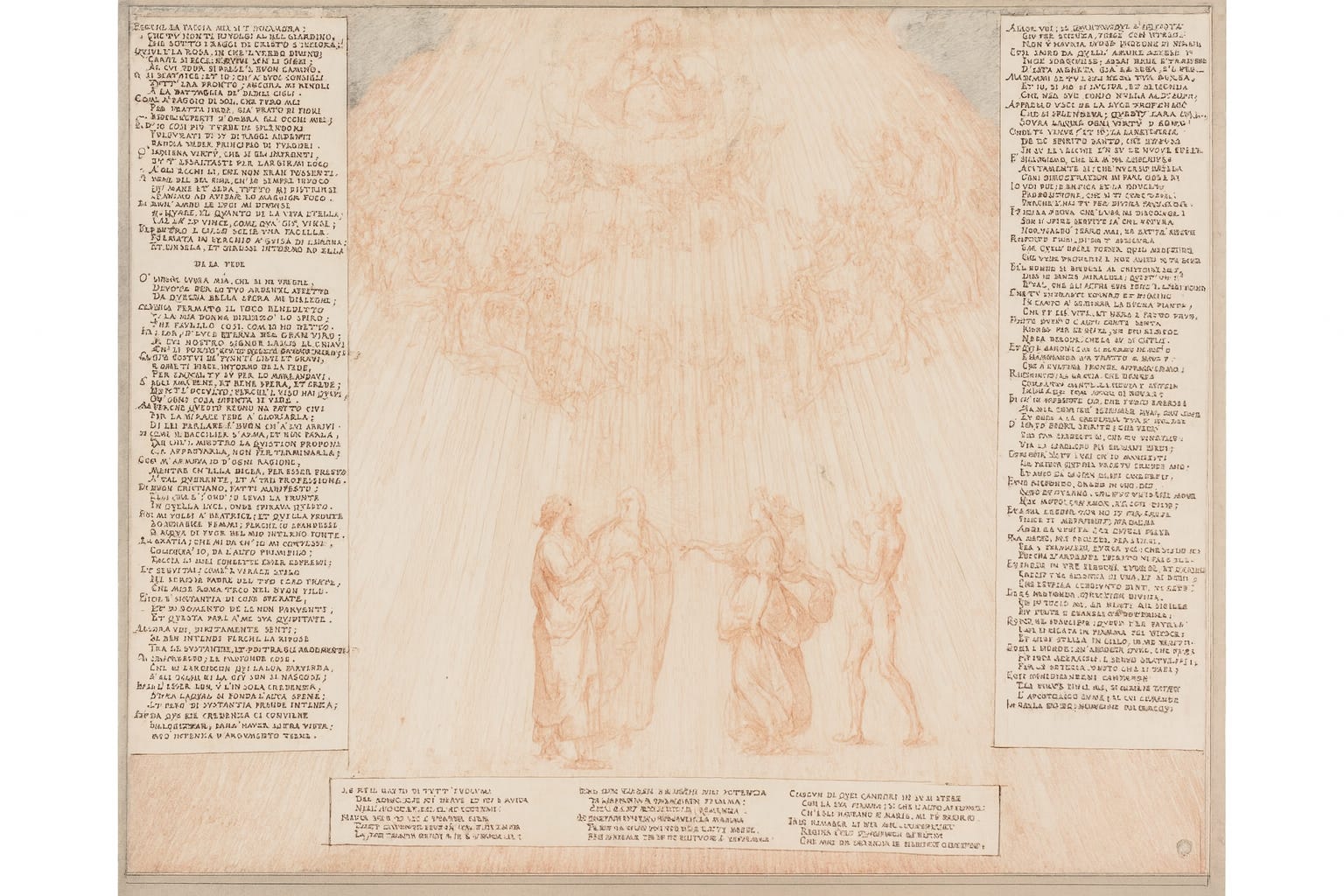
The brightness of the three souls in that dance made Dante strain to look at them, his sight overwhelmed:
Even as he who squints and strains to see
the sun somewhat eclipsed and, as he tries
to see, becomes sightless, just so did I
in my attempt to watch the latest flame,
until these words were said: “Why do you daze
yourself to see what here can have no place?”
xxv.118-123
It was John who spoke to him, laying to rest the legend that he had risen, deathless, to heaven, knowing that Dante peered at him attempting to see his still human flesh there within the light; John assured him that his physical body was still on earth, buried, waiting for the resurrection, which would not come until the numbers of the elect were fulfilled. Only Christ and Mary had risen to heaven, embodied:
On earth my body now is earth and shall
be there together with the rest until
our number equals the eternal purpose.
Only those two lights that ascended wear
their double garment in this blessed cloister.
And carry this report back to your world.”
xxv.124-129
Their dance and message complete, their movements ended as quickly as would the oarsmen on a boat stop as one at a signal, and Dante found himself, on turning to find Beatrice, blinded by the light.

💭 Philosophical Exercises
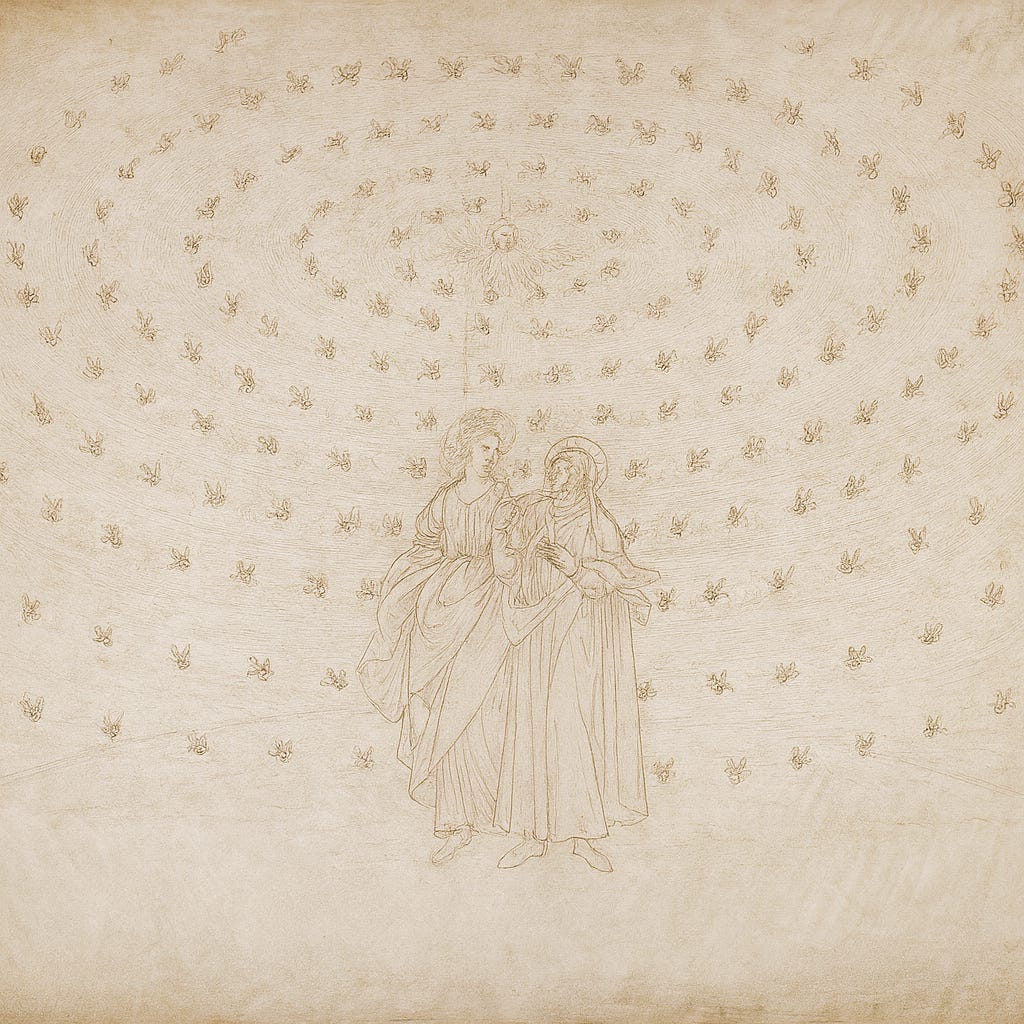
I want to begin with a question for my reader.
If you were writing Dante’s Divine Comedy, this section in particular, the great triad of Cantos XXIV, XXV, and XXVI, nd you had to choose the order in which the three apostles appear before you, which order would you choose? If you had to decide how to arrange Faith, Hope, and Love as three examining lights in Heaven, how would you do it?
Would you begin with Faith, then move to Hope, then Love?
Or would you start with Hope?
Or would you end with Faith?
If my reader wishes, they can pause for a moment and think about it.
My attempt here is to understand the logic, the architecture, the hidden message Dante encodes in the sequence of these three celestial encounters. Because Dante, more than any other poet, constructs meaning not only through what he says, but through the order in which he says it. The structure is the teaching.
And the first figure he chooses is Saint Peter, the apostle of Faith.
Peter examines Dante on his faith because to borrow and adapt a well-known philosophical line the unexamined faith is not worth living. What is the wisdom behind that idea?
Faith is not a vague spiritual feeling. Faith represents a direction. It is the orientation of one’s inner vision. What you focus on is where you walk; your attention is the compass of your life. So when Peter examines Dante on his faith, he is really asking: What do you choose to see? What do you orient your soul toward?
Think of it this way: when we leave our house to walk somewhere, we usually know roughly which direction to take. We know the streets, the path we intend to follow. But rarely can we see the final destination from where we stand. Faith is the ability to hold the destination in mind even when it’s invisible to the eyes. It is the clarity of purpose that allows the journey to begin.
This, I believe, is why Dante places Saint Peter first and not last or in the middle. Before you begin the ascent toward God, you must clean the lenses of your interior sight. If the lenses are dirty, the entire journey becomes muddled. Peter establishes the direction.
Then comes Saint James, the apostle of Hope.
When James arrives, Dante constructs a dual movement, a kind of dance between two realities: the heavenly and the earthly. On the heavenly side, James asks the great questions: What is hope? How does it blossom in you? What is its source? And what always astonishes me in these cantos is how open Dante’s universe is. Nothing is taken for granted. Nothing is left unexamined. There is no dogmatic enclosure here. Everything is interrogated in a Socratic, almost philosophical manner: What is faith? What is hope? What is love?
But the earthly dance — that is where things become even more interesting.
My reader may recall that in the Inferno we met Brunetto Latini, Dante’s mentor, condemned among the sodomites for having sought earthly fame, a fame rooted in the shifting sands of time and politics. Brunetto wrote to be remembered by the world, not to transform it. His pursuit was earthly glory, measured by the applause of his century.
In Paradiso 25, Dante returns to his native Florence, not physically but imaginatively. He speaks of the Baptistery, the ovile — the sheepfold — where he was “a lamb.” He remembers the place that gave him faith. And then he expresses the hope that Florence might one day accept him back.
But Teodolinda Barolini helps us see the deeper meaning behind this. Dante’s hope here is not merely the desire to return physically to Florence, though he certainly wanted that. His hope is of a different order. Here, for the first time, he calls himself sacro poeta, sacred poet. His hope is that by creating a poem so holy, so beyond earthly politics, so unlike Brunetto Latini’s chase for temporal fame, his work would one day return him to Florence in a way that politics never could.
Barolini reminds us of something remarkable: in 1315, while Dante was in exile, the world revived the ancient custom of crowning poets with the laurel. But the honour did not go to Dante. It went to Albertino Mussato, celebrated for his Latin tragedy Ecerinis, which condemned the tyrant Ezzelino da Romano. Mussato wrote on contemporary politics — politics that Dante also cared about deeply — but Mussato’s work did not reach the sacred, universal depth of the Commedia.
And now the irony becomes almost cosmic: today, even in Florence itself, even among its educated citizens, very few remember Mussato’s name. Many remember Ezzelino, the villain of his play but not Mussato, the poet who attacked him.
Time has revealed the difference between poetry that wins a political coronation and poetry that crowns itself by its own sacred force. Dante did not receive the laurel in 1315. But in 2021, seven hundred years after his death, Florence finally did what Dante hoped it would: it recognised him as its true, eternal poet laureate.
The hope of Paradiso XXV was fulfilled, just not in Dante’s lifetime.
But the canto does not stop here. It moves toward its most astonishing moment.
After the examination on hope, after the heavenly chanting of “Sperent in te”, after the sublime appearance of Saint John, Dante turns around — and Beatrice is no longer there.
For the first time since the dark wood, Dante finds himself without a guide. Not Virgil. Not Beatrice. No one. He turns and she is gone.
And this is where hope becomes existential, not theological. When do we need hope the most? When we look around and find no companion beside us. When we feel we must walk the next step alone. When no external resource, no guide, no Beatrice, stands ready to interpret reality for us.
Hope begins exactly where our visible guides end.
Dante knows that Beatrice’s disappearance is not abandonment but initiation. He must now act with the virtues he has learned. He must trust the orientation Peter helped him clarify, and the expectation of future blessedness that James helped him articulate. Hope is no longer something outside; it becomes something within him.
And this allows us to ask, finally: what is hope for us?
Not the modern idea that the world must unfold according to our desires. Not the illusion that our plans will be executed by the universe. Hope is something quieter, deeper, fiercer. It is the conviction that if you set your vision, your faith — toward what is true and good, and if you walk in that direction with sincerity, the outcome of your life will not be chaos. It will not be meaningless. It will take on a harmony that may not match your original expectation, but will match the truth of who you have become.
Hope is the trust that your soul will be able to meet reality, to arrange itself in relation to truth, to endure, to understand, to grow into beauty. Hope is the inner certainty that the final destination, though invisible not, will justify the journey.
And perhaps this is why Beatrice disappears. Because for hope to become real, for the soul to stand on its own, the guide must step aside. Hope is the virtue that teaches us how to walk when no one is watching, how to continue upward when the hand we relied on has let go.
Faith shows us the direction.
Hope sustains us when the path is empty.
And Love, the fire that John embodies, waits just ahead.

This Week’s Sinners and Virtuous 🎭
(Themes, Quotes, Terms and Characters)
I. The Sacred Poem
At the start of Canto XXV, Dante voices a hope that is both fragile and audacious: if his poema sacro, “the sacred poem to which heaven and earth have put a hand” can overcome Florence’s cruelty, he will return to the “fair sheepfold where I slept as a lamb” and receive the laurel at the Baptistery.
Barolini hears both pathos (he never returned) and triumph: Psalm 23’s “green pastures” console the exile, while Dante inserts himself into the new culture of laurel coronations after Mussato and, above all, self-anoints as the unique poeta of Paradiso, whose future “ritornerò poeta” history eventually fulfils.
Quotes 🖋️
(The ones I keep in my journal as reminders of eternal wisdom):
At first, as soon as I had finished speaking,
“Sperent in te” was heard above us, all
the circling garlands answering this call.

And then, among those souls, one light became
so bright that, if the Crab had one such crystal,
winter would have a month of one long day.

~ lines 97--102, Paradiso, Canto XXV

Charles S. Singleton, Commentary on the Paradiso 400
Dorothy L. Sayers, Paradise 279
Sayers 279
Allen Mandelbaum, The Divine Comedy 772
Christian Heck, The Grand Medieval Bestiary 480
Here is Sperent in Te as Dante would have heard it. Sung just the same way at the Mass.
https://www.youtube.com/watch?v=-r0eh1dYdq8
“I asked God for flowers, and he gave me rain.”
Your request to propose a reordering of the theological virtues sounds like a trick question formulated by one of the three saints!
I momentarily held the notion that hope (a desire for good) should be promoted as a prerequisite, and impetus, for faith. Alas, while that might be understandable in my (admittedly poorly formulated) modern conception, it’s almost the exact reverse of how Dante (with his medieval theology and dramatic flair) ordered the virtues. My reordering would be theologically incoherent to Dante; his sequence was the universal adoption in his day.
This canto is an important reminder of why I have to avoid presentism by continuously reminding myself medieval people are not “just like us,” and our modern conceptions often impair our understanding (as I see I have sadly demonstrated in previous comments). I’ve noted before the apt line from L.P. Hartley’s “The Go-Between”: “The past is a foreign country: they do things differently there.” Perhaps the best metaphor to understand the Middle Ages is one commonly used in teaching classical literature: imagine you’re an anthropologist landing on a planet where God is as real as gravity, theology is the queen of the sciences, and social order is divinely ordained. Reminded I am.
Dante himself makes an explicit statement of virtue prioritization via Beatrice; she requests the first query be about “…the faith by which you [St. Peter] walked upon the sea…” She says “There is no child of the Church Militant who has more hope than he has…” which affirms to Saint Peter that because Dante’s faith is so perfect, his hope is correspondingly strong. (This is another point where my modern conception of hope introduces error: ordinary hope always includes real fear of failure or disappointment, but theological hope can’t fail or disappoint if it is focused solely on the one and only possible object: eternal life in union with God.)
I also don’t dare get crosswise with Dante’s “light of the intellect” (Thomas Aquinas), who said faith is the foundation of all the other theological virtues: “Without faith there is no knowledge of the supernatural end (God), and therefore neither hope nor charity can even exist.”
The poet’s faith clarifies this object of desire (union with God), and hope is his longing for attaining that object. My dalliance with privileging hope over faith is the all-to-common (modern) error of experiencing desire first and then formulating beliefs to match it. You don’t hope your way into faith. First, God reveals Himself; faith is then born; then, and only then, can we desire (hope for) union.
Finally, I’m reminded of the saying: “I asked God for flowers, and he gave me rain.” Dante asked for flowers (laurels, a return to Florence), and God let it rain in order to fill Dante with the virtue of Hope so he could return to Earth and inspire others (“…so that I am full and rain again your rain on other souls”). We’re in Isaiah 55:10–11 territory, aren’t we?
10 “For as the rain and the snow come down from heaven
and do not return there but water the earth,
making it bring forth and sprout,
giving seed to the sower and bread to the eater,
11 so shall my word be that goes out from my mouth;
it shall not return to me empty,
but it shall accomplish that which I purpose,
and shall succeed in the thing for which I sent it.”